

The increasing sophistication of AI detectors has created a new challenge for content creators who use AI writing tools. Learn how AI is transforming content writing and reshaping the way blogs and articles are created. Whether you’re drafting blog posts, academic papers, or professional communications, having your content flagged as AI-generated can sometimes undermine its credibility. This guide will show you practical ways to avoid AI detection while maintaining integrity in your content creation process. With the right approach, you can leverage AI assistance while ensuring your final output reads naturally and passes AI detection tools.
What is AI detection
AI detection refers to technologies and algorithms designed to identify whether text was created by artificial intelligence rather than a human writer. For insights into how AI is integrated into search, check out Google AI Mode Explained. These detection systems analyze patterns, predictability, and linguistic characteristics that typically distinguish AI-generated content from human writing. As AI writing tools have become more prevalent, detection systems have evolved to keep pace.
How is AI-generated content detected?
AI detectors work by analyzing several key patterns that often appear in machine-generated text. They look for telltale signs like repetitive phrasing, predictable word choices, uniform sentence structure, and a lack of personal voice. These tools use machine learning algorithms trained on thousands of examples to recognize subtle patterns more common in AI-generated content than human writing. Detectors often evaluate factors like sentence length variation, complexity, repetition, and the absence of nuanced personal details that humans naturally include in their writing.
Limitations of AI Detection (Why It’s Not 100% Accurate)
AI detection tools are helpful but far from perfect. They provide probability-based assessments rather than absolute proof. This means:
False positives → Human-written text flagged as AI-generated.
False negatives → AI-generated text passes as human.
Evolving AI models → As AI tools improve, detection systems struggle to keep up.
Variety in human writing → Different styles, tones, and complexities make it hard for detectors to be 100% reliable.
Google’s Perspective: Google has clarified that it does not use AI detection tools or classifiers to determine search rankings. Instead, it evaluates content based on helpfulness, originality, and user value, regardless of whether AI was involved in its creation. The focus remains on meeting Google’s E-E-A-T standards, Experience, Expertise, Authoritativeness, and Trustworthiness, not on how the content was produced.
7 ways to avoid AI detection responsibly
Creating content that passes AI detection doesn’t mean being deceptive. Instead, it’s about adding your human touch to enhance AI-generated drafts. Here are seven effective approaches:
1. Mix AI With Human Editing
AI tools are great for drafting, but raw outputs often sound mechanical. To avoid detection:
Start with AI for structure or idea generation.
Rewrite sentences in your own words.
Add your personal touch with examples, anecdotes, or brand voice.
Example: If AI writes “AI detection tools use algorithms to identify machine text”, rewrite it as “Most AI checkers rely on algorithms, but the smartest readers can often sense when something feels ‘too perfect’.”
Why it works: Detectors flag robotic sentence patterns. Your human voice makes the text flow naturally.
2. Change Sentence Structures and Lengths
AI tends to create uniform sentences (medium length, straightforward). Break this pattern by:
Using a mix of short, punchy lines and long, descriptive sentences.
Adding transitions like “however,” “on the other hand,” “let’s take an example”.
Avoiding repetitive phrasing.
Example: Instead of three medium sentences in a row, combine two into one longer sentence and break another into a quick one-liner.
Why it works: Variation mimics how humans naturally write, making content harder to flag.
3. Add Real Examples, Data, or Case Studies
AI struggles with real-world context. Strengthen your content by inserting:
Statistics (with references).
Industry examples (e.g., “In marketing,…” “For students writing essays,…”).
Personal experience (even small ones).
Example: If you’re writing about blogging, mention how you used Grammarly and Hemingway together to edit a draft.
Why it works: Detectors look for generic text. Specific details prove human involvement.
4. Use Synonyms and Rephrasing Tools
AI-generated text often sticks to a predictable vocabulary. Make it richer by:
Replacing common AI words (like “utilize,” “moreover,” “in addition”) with natural alternatives.
Using tools like Thesaurus.com or manual rewriting.
Keeping your audience in mind, casual readers prefer simple, direct words.
Example: Instead of “AI content detection is becoming increasingly popular”, write “More and more platforms are now using AI checkers to catch machine-written text.”
Why it works: A wider range of vocabulary makes the content feel authentic.
5. Break Up the Monotony With Formatting
AI tends to produce large blocks of text. Humans write with flow and structure. Try:
Using bullet points, subheadings, and numbered lists.
Adding quotes or bold text to emphasize ideas.
Inserting questions like “But how can you make this sound natural?”
Example: Instead of a single 7-line paragraph, split it into 3 smaller chunks with bullets.
Why it works: Detectors scan for uniformity. Varied formatting makes it look more human.
6. Paraphrase AI Output With Humanizer Tools
If you rely heavily on AI drafts, pass them through AI humanizer tools before publishing. Tools like:
Rayo Humanizer – rewrites content with a natural tone.
Quillbot – paraphrases while maintaining meaning.
Hemingway Editor – simplifies and balances sentence flow.
- Undetectable AI – rephrases AI text in a way that reduces the chance of being flagged by detectors.
Tip: Don’t just copy-paste; always review and tweak the final version.
Why it works: These tools help disguise machine patterns and make your text sound authentic.
Comparison Table: Best AI Humanizer Tools
| Tool | Key Features | Success Rate | Best For | Pricing |
|---|---|---|---|---|
| Rayo Humanizer | Customizable tone, context preservation | High | Academic + professional writing | Free + Premium |
| Humanizer.io | Aggressive, enhanced, keyword lock | 99.54% (claimed) | General content creators | Free |
| QuillBot | Style-matching, flow improvement | 4.7/5 (4.5M+ users) | Bloggers & students | Free + Premium |
| Undetectable AI | Advanced humanizing algorithm | Works with GPTZero, Turnitin | SEO & web content | Paid |
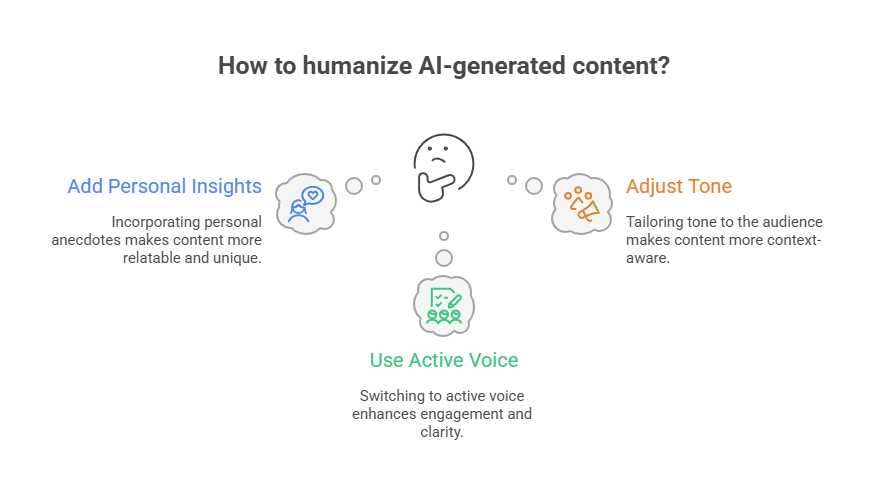
7. Add Personal Insights and Opinions
The best way to beat AI detection? Write like only you can. Add:
Personal stories (“When I first tried ChatGPT…”).
Strong opinions or comparisons.
Localized or niche-specific knowledge.
Example: If writing about SEO, add your take: “From my experience, Google doesn’t just penalize AI-written content, it penalizes low-value content, whether human or AI.”
Why it works: Detectors can’t replicate your personal experience, making your content unique and trustworthy.
Best Practices Before Publishing AI-Assisted Content
Before publishing, always:
Run your draft through AI detection tools (GPTZero, Originality.ai, Turnitin).
Perform a plagiarism check to ensure originality.
Add personal insights, anecdotes, or examples.
Do at least one manual rewrite pass for tone and flow.
Read aloud to catch robotic or repetitive phrasing.
How to See if Your AI Content is Detectable
Before publishing content that includes AI assistance, it’s smart to check whether it might trigger detection tools. Several AI content detection platforms let you test your text and give feedback on how “human” it appears.
These detectors analyze writing patterns, looking for common AI characteristics such as:
Repetition and predictability
Uniform sentence structures
Overly polished phrasing
Lack of personal voice or insights
They utilize machine learning algorithms trained on extensive datasets comparing human and AI writing. When reviewing your results, pay close attention to feedback about sentence variety, natural language flow, and unpredictability, which are all hallmarks of human writing.
In short: if your content feels too robotic, consistent, or generic, there’s a good chance detectors will flag it.
Comparison Table: Best AI Humanizer Tools
| Tool | Key Features | Success Rate | Best For | Pricing |
|---|---|---|---|---|
| Rayo Humanizer | Customizable tone, context preservation | High | Academic + professional writing | Free + Premium |
| Humanizer.io | Aggressive, enhanced, keyword lock | 99.54% (claimed) | General content creators | Free |
| QuillBot | Style-matching, flow improvement | 4.7/5 (4.5M+ users) | Bloggers & students | Free + Premium |
| Undetectable AI | Advanced humanizing algorithm | Works with GPTZero, Turnitin | SEO & web content | Paid |
Conclusion
Avoiding AI detection doesn’t mean being dishonest about using AI tools; it simply means being transparent about their use. It’s about adding your human perspective and creative touch to ensure the final product reflects your voice and ideas. By incorporating personal elements, varying your writing style, and using humanizer tools when needed, you can create content that seamlessly blends AI efficiency with human creativity. Remember that the best approach is to use AI as a starting point or assistant rather than relying on it completely. With these strategies in hand, you can confidently create content that remains authentic while passing AI detection tools.
FAQs
How do I make my writing that passes AI detection?
To create writing that passes AI detection, incorporate personal anecdotes, vary your sentence structure, use conversational language with contractions, and edit the content across multiple sessions. Reading your content aloud helps identify mechanical-sounding sections that need revision. The key is adding your unique perspective and voice to any AI-generated draft.
What are the best ways to make text not AI detectable?
The best approaches to make text not AI detectable include adding imperfections and natural language patterns, incorporating personal experiences only you would know, varying paragraph and sentence lengths, and using humanizer tools like Quillbot or Humanizer.io. Breaking up predictable patterns that AI tends to create will help your content appear more authentically human.
How to make AI not sound like AI in long-form content?
For long-form content, make AI not sound like AI by creating a consistent personal voice throughout, including tangential thoughts that show human reasoning, varying transitional phrases between sections, and incorporating culturally relevant references or idioms. Long content particularly benefits from multiple editing passes where you can layer in complexity and nuance that AI typically lacks.
Can AI writing pass detection if rewritten manually?
Yes, AI writing can successfully pass detection when thoroughly rewritten manually. The key is restructuring sentences, adding personal insights, varying vocabulary choices, and incorporating your unique tone and perspective. Manual rewriting allows you to infuse the content with human qualities that AI detectors look for, making it virtually indistinguishable from fully human-written content.
Are there reliable AI detection tools to check my writing?
Several reliable AI detection tools can check your writing before publication. Popular options include GPTZero, Originality.ai, Content at Scale’s AI detector, and Turnitin. These tools analyze your content for patterns common in AI-generated text and provide feedback on how likely your content is to be flagged as AI-created. Testing your content with these tools allows you to further humanize sections that trigger detection.

Ridam Khare is an SEO strategist with 7+ years of experience specializing in AI-driven content creation. He helps businesses scale high-quality blogs that rank, engage, and convert.