

If you’ve ever stared at a blank page, unsure of where to start your blog post, you’re not alone. But these days, you might have a powerful assistant ready to help, Artificial Intelligence in blog writing (AI). Over the past few years, AI has been changing the way we do many things, from shopping to driving. Now, it’s transforming the way blogs are written, making content creation faster, smarter, and more efficient.

So how exactly is AI reshaping the blogging world? Let’s dive into how this technology is revolutionizing content writing and what it means for businesses, writers, and readers alike.
What Is AI and How Does It Fit into Content Writing?
Before we explore the impact, let’s quickly break down what Artificial Intelligence really is. In simple terms, AI refers to machines or software that can mimic human thinking. This includes learning from data, recognizing patterns, and even making decisions.
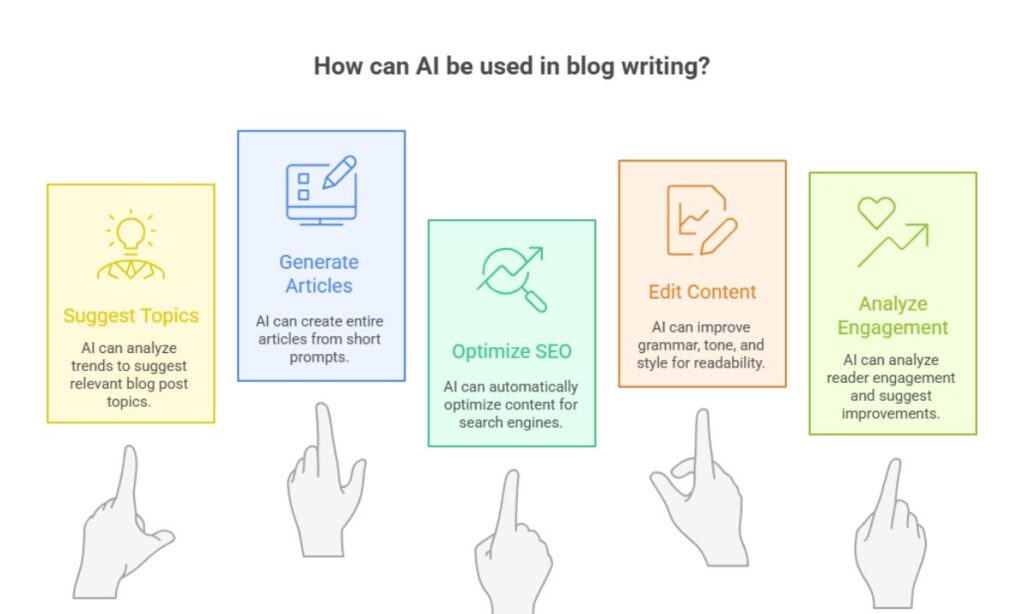
When it comes to blog writing, AI tools can now:
- Suggest blog post topics based on current trends
- Generate entire articles from a short prompt
- Optimize content for SEO automatically
- Edit grammar, tone, and style for readability
- Analyze reader engagement and suggest improvements
Sounds impressive, right? And the best part? These tools are becoming more advanced every day, thanks to deep learning and natural language processing technologies.
The Rise of AI Writing Tools
You may have heard of platforms like ChatGPT, Rayo, Jasper, or Copy.ai. These AI writing tools have exploded in popularity in recent years. In fact, according to a 2024 report by Statista, the global AI content creation market is expected to reach $42.1 billion by 2025, nearly triple what it was just two years ago.
These tools allow content creators to produce more blogs in less time, something that was almost unimaginable just a decade ago. Whether you’re a solo blogger or part of a digital marketing team, AI is helping you stay competitive in a content-driven world.
“According to HubSpot’s State of AI in 2025 report, 66% of marketers globally use AI in their roles, showing that AI is no longer a side-tool but embedded in workflows. HubSpot Blog”
Saving Time Without Sacrificing Quality
I remember a time when writing a single blog post would take me up to a full day. Planning the structure, optimizing for keywords, editing… it was a lot. Now, with the help of AI, I can outline, write, and even publish a fully optimized post in just a few hours. That’s a game-changer.
How AI Helps with SEO
Let’s be honest, Search Engine Optimization (SEO) can get overwhelming. But it’s also crucial if you want your blog to get found online. This is where AI can be your silent partner. Learn more about Google AI Mode and how it affects content and search to understand how AI-driven search changes SEO strategy.
“Nearly 3 out of 4 marketers are using some kind of AI tool at work; HubSpot reports that 74% have adopted it in their daily tasks. HubSpot”
Modern AI tools can:
- Find the best keywords for your niche
- Create SEO-friendly titles and meta descriptions
- Suggest internal and external links
- Measure readability and keyword density
- Track how well your blog posts are performing
By automating these tasks, you can focus more on telling your story while still hitting those important SEO checkboxes.
Personalization at Scale
Here’s a fun fact: AI doesn’t just help write blogs, it also helps tailor them to specific readers. Ever wondered how some blogs seem to speak directly to your interests? That’s often the result of AI-powered personalization.
Through data analytics and user behavior tracking, AI can suggest which content types perform best with your audience. This means a fitness blog might recommend more diet-related posts to health-conscious readers, while pushing muscle-building workouts to gym enthusiasts. It’s like giving every reader their own custom reading list.
Common Concerns About AI in Blog Writing
Despite the many benefits, it’s natural to have a few concerns. Some common questions include:
“Will AI replace human writers?”
Not likely. AI is great at handling repetitive tasks and data-driven content, but when it comes to creativity, emotion, and storytelling, human writers still have the upper hand. Think of AI as a writing partner, not a replacement.
“Can AI-generated content be trusted?”
This depends on how it’s used. On its own, AI can sometimes make factual errors or misunderstand context. That’s why human editors need to vet all content before publishing.
“While adoption is high, only about 1% of companies are at full AI maturity; meaning they’ve properly integrated it into workflows with strong oversight. McKinsey & Company”
New Developments and Technologies in 2025
So, what’s new in the world of AI and blog writing?
- Real-time SEO insights: Platforms like Surfer SEO, Rayo and Clearscope now give blog writers real-time feedback to improve their articles’ chances of ranking.
- Voice-to-text AI: Tools like Otter.ai and Whisper (developed by OpenAI) convert spoken thoughts into written format, helping writers brainstorm ideas on the go.
- AI fact-checking: New tools are emerging that compare AI-generated content against trusted news sources to reduce misinformation.
- Emotion-aware writing: Some newer models can now adjust writing tone based on the emotional impact, say, making it more empathetic or more persuasive as needed.
Tips for Using AI in Your Blog Writing Process
If you’re ready to welcome AI into your blogging routine, here are some tips to get started:
- Start small: Use AI to draft outlines or generate title ideas first.
- Mix human and AI effort: Let the AI write a rough draft, then polish it with your voice and style. If you’re concerned about AI detection, check out our tips on how to avoid AI detection in writing without losing quality for practical strategies.
- Always fact-check: Don’t assume AI content is 100% accurate. Verify data before publishing.
- Use multiple tools: Combine AI writing tools with SEO analyzers, grammar checkers, and image generators for best results.
The Future of Blogging Is a Human-AI Partnership
At the end of the day, blogging is still about connecting with people. And while AI can help speed up the process and improve your content’s reach, it’s your unique voice that keeps readers coming back.
So instead of asking, “Will AI take over blog writing?” maybe we should be asking, “How can we work with AI to write better blogs?”
In 2025 and beyond, the future of blog writing is not just about who writes, it’s about how we write. And with smart technology and a human touch, we’re on the brink of something truly transformative.
Are you ready to join the AI-powered blogging revolution?
Frequently Asked Questions (FAQs)
Q1. Can AI completely replace human blog writers?
No. AI is excellent at generating drafts, analyzing data, and improving efficiency, but it lacks the creativity, emotional depth, and unique voice that human writers bring. The future is more of a partnership between AI and humans rather than a full replacement.
Q2. Is AI-generated content good for SEO?
Yes, if used wisely. AI can help with keyword research, readability, and content structure. However, Google prioritizes helpful, original content. AI content still needs human editing and fact-checking to rank well.
Q3. How can I make AI-written blogs sound more natural?
For readers curious about whether AI-generated content can be identified, see our guide on can anyone recognize if ChatGPT was used for writing for insights on detection and accuracy.
Q4. Are there risks in using AI for blog writing?
Yes. Common risks include factual inaccuracies, generic writing style, and possible over-optimization for SEO. To minimize risks, always verify facts and add a human perspective.
Q5. What are the best AI tools for blog writing in 2025?
Popular tools include ChatGPT, Jasper, Copy.ai, Rayo for writing, Surfer SEO and Clearscope for optimization, and Grammarly or QuillBot for polishing grammar and tone.
Q6. How do AI detectors know if content is AI-written?
AI detectors analyze patterns in writing, such as predictability, sentence structure, and token usage. While improving, they are not 100% accurate, so human judgment is still necessary.
Q7. Will Google penalize AI-written content?
Not directly. Google has clarified that content is judged by quality, helpfulness, and originality, not by whether it’s written by a human or AI. Poorly edited or low-value AI content may harm rankings, but well-polished AI-assisted writing is acceptable.

Ridam Khare is an SEO strategist with 7+ years of experience specializing in AI-driven content creation. He helps businesses scale high-quality blogs that rank, engage, and convert.