

In the competitive SaaS landscape, standing out isn’t just about having a great product – it’s about being found when prospects search for solutions to their problems. But SaaS SEO isn’t like regular SEO. The B2B buying journey is complex, with longer sales cycles and higher transaction values that demand a more strategic approach to content creation and optimization.
For SaaS companies, effective SEO isn’t just about traffic – it’s about attracting the right visitors who convert into demos, trials, and paying customers. Your content needs to build trust while guiding prospects through a complex decision-making process that often involves multiple stakeholders.
Let’s dive into actionable strategies that will help your SaaS business climb search rankings while actually driving revenue – not just vanity metrics.
Build your SaaS SEO foundation
Find SEO-friendly niche topics
Success in SaaS SEO starts with finding topics where you can actually compete and win. Look beyond obvious high-volume keywords that every competitor targets. Instead, use tools like Ahrefs, SEMrush, or even Google’s “People Also Ask” sections to uncover niche topics with decent search volume but less competition.
Focus on specific pain points your product solves rather than generic industry terms. For instance, instead of targeting “CRM software” (incredibly competitive), you might focus on “CRM for independent financial advisors” if that’s your specialty.
Another goldmine? Analyze questions your existing customers ask during sales calls or support tickets. These real-world queries often reveal SEO opportunities competitors miss because they’re too focused on high-volume keywords.
Run in-depth keyword mapping
Keyword mapping for SaaS goes beyond basic research. It’s about connecting search terms to your buyer’s journey. Start by creating a comprehensive list of relevant keywords, then categorize them by:
- Awareness stage: Educational terms like “what is [product category]”
- Consideration stage: Comparison terms like “[product] vs [competitor]”
- Decision stage: Purchase-intent terms like “[product] pricing”
Prioritize keywords based on a combination of search volume, competition, and business impact. A keyword with moderate volume but high purchase intent is usually more valuable than a high-volume informational keyword with little conversion potential.
Use Google Search Console to identify keywords you already rank for but could improve, then map them to specific pages. This reveals content gaps where you need new pages or improvements to existing ones.
Structure URLs, titles, and metadata
Your site architecture creates the foundation for effective SaaS SEO. Keep URLs short, descriptive, and logical. For example, use “yoursaas.com/features/reporting” instead of long, parameter-heavy URLs that confuse both users and search engines.
For page titles, front-load important keywords while still making titles compelling. Keep them under 60 characters to prevent truncation in search results.
Meta descriptions should function as mini-ads that encourage clicks. Include your primary keyword naturally, address a pain point, and add a clear call to action – all within 155 characters.
Implement schema markup to enhance your search listings with rich snippets. For SaaS companies, “SoftwareApplication” schema can display ratings, pricing, and other details directly in search results, increasing click-through rates.
The details are not the details. They make the design
— Charles Eames
Create a revenue-focused SaaS SEO content strategy
Map TOFU, MOFU, and BOFU gaps
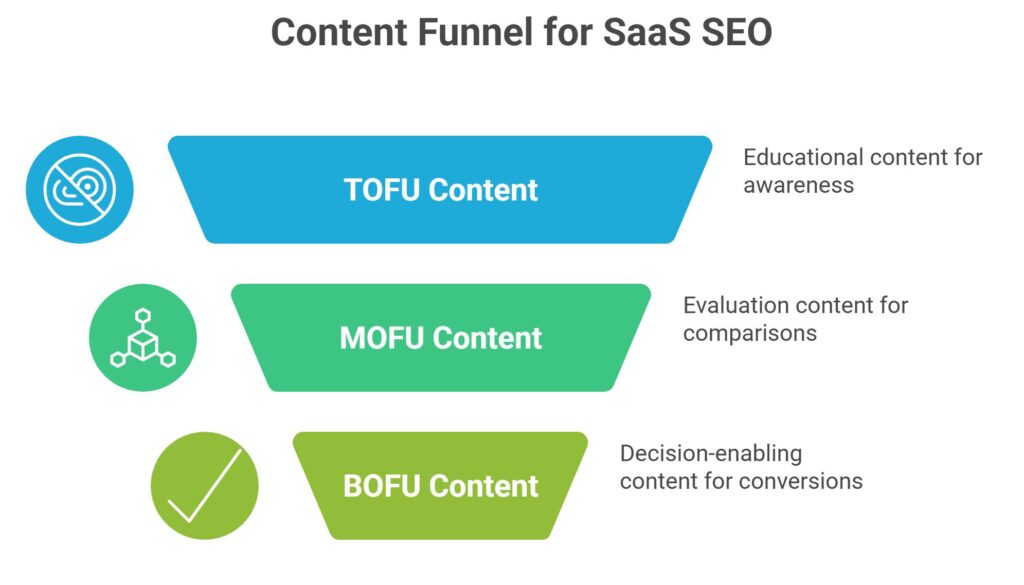
A balanced content funnel is critical for SaaS SEO success. Many companies overinvest in top-of-funnel (TOFU) content like basic guides, neglecting the middle and bottom where actual conversions happen.
Audit your existing content and categorize by funnel stage:
- TOFU: Educational content that builds awareness
- MOFU: Evaluation content that helps with comparisons
- BOFU: Decision-enabling content that removes purchase barriers
Look for imbalances. If you have 50 TOFU blog posts but only two comparison pages, you’ve identified a MOFU gap. Create a content calendar that addresses these gaps, focusing first on stages closest to conversion.
Use internal linking strategically to guide readers from TOFU to MOFU to BOFU content. Each piece should naturally lead to the next logical step in the buyer’s journey.
Use intent-based clustering
Not all keywords with the same volume have the same value. Intent-based clustering groups keywords by user intention rather than just search volume or topic similarity.
The four main search intents are:
- Informational: Users seeking knowledge (“how to improve team collaboration”)
- Navigational: Users looking for a specific site (“Slack login”)
- Commercial: Users researching before purchase (“best team chat apps”)
- Transactional: Users ready to buy (“Slack pricing plans”)
Cluster your keywords by these intents, then create content templates optimized for each type. For informational content, comprehensive guides work well. For commercial intent, comparison tables and feature breakdowns perform better.
Build content driven by conversion paths
Every piece of SEO content should have a clear next step for the reader. Map out your ideal customer journeys from first touch to conversion, then design content that facilitates this progression.
For example, a reader who lands on a beginner’s guide might be prompted to download a detailed whitepaper (collecting their email). Later emails can direct them to product-focused content, case studies, and eventually a trial sign-up page.
When planning content, always ask: “What do I want the reader to do next?” and “How does this piece move them closer to becoming a customer?” This approach transforms your content from isolated blog posts into a cohesive conversion machine.
Optimize content for demo and trial sign-ups
The ultimate goal of SaaS SEO is generating qualified leads through demos and trials. Optimize these conversion points:
- Place contextual CTAs within content rather than generic banners
- Test different CTA language (e.g., “Start Free Trial” vs. “Try It Risk-Free”)
- Reduce form fields to the minimum required
- Highlight social proof near sign-up buttons (“Join 10,000+ teams already using [Product]”)
Use heat mapping tools to identify where visitors abandon your sign-up process. Implement A/B testing for landing pages and sign-up flows. Even small improvements in conversion rate can dramatically increase ROI from your SEO efforts.
Apply B2B SEO strategies for scalable traffic
Strengthen E-E-A-T for B2B credibility
Google’s E-E-A-T (Experience, Expertise, Authoritativeness, and Trustworthiness) principles are particularly important for B2B SaaS, where purchase decisions involve significant investment and risk.
Build expertise by:
- Having content authored by genuine subject matter experts
- Including author bios that highlight relevant credentials
- Providing depth and unique insights rather than superficial coverage
Enhance authoritativeness through:
- Securing backlinks from respected industry publications
- Publishing original research and data
- Speaking at and covering industry events
For B2B SaaS specifically, demonstrate deep understanding of industry-specific challenges your customers face. This specialized knowledge signals to both search engines and potential customers that you’re a credible solution provider.
Use comparison and review pages smartly
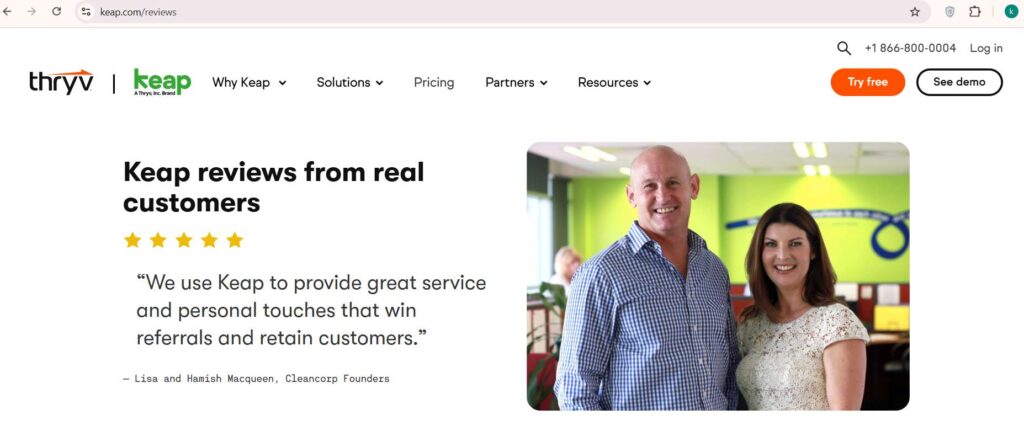
Comparison and review content often captures high-intent traffic from prospects actively evaluating solutions. Create “versus” pages comparing your product to competitors, but take an educational rather than overly promotional approach.
Effective comparison pages should:
- Fairly represent competitor strengths while highlighting your unique advantages
- Use objective criteria for comparisons (features, pricing structures, support options)
- Include use case scenarios to help visitors determine the best fit for their needs
Beyond direct competitor comparisons, create content addressing “alternatives to [your product]” searches. These pages build trust by showing you’re not trying to be everything to everyone.
Update comparison content quarterly as features and pricing change to maintain accuracy and credibility.
Create dedicated product-led blog funnels
Rather than treating your blog as separate from your product marketing, create dedicated content clusters that showcase product capabilities through educational content.
For each major feature or use case, create a mini-funnel:
- A cornerstone guide explaining the concept or challenge
- Supporting articles addressing specific aspects or questions
- Case studies showing real-world implementation
- A feature page that ties everything together
For example, if your product includes team collaboration features, create a cluster around “improving team collaboration” with articles on communication techniques and remote team management – all subtly demonstrating how your product solves these challenges.
Develop use case targeting through SEO
Different customer segments use your product in different ways. Use case targeting means creating content specifically addressing these varied applications of your solution.
Start by identifying your primary use cases through customer interviews and usage data. For each use case, develop content that:
- Explains the specific challenge this customer segment faces
- Shows how your product addresses their unique needs
- Provides implementation guidelines specific to their situation
- Features testimonials from similar customers
This approach improves conversion rates by speaking directly to specific audiences rather than trying to address everyone with generic content. It also helps you rank for highly specific long-tail keywords with strong purchase intent.
Tie your SaaS SEO to growth KPIs
Successful SaaS SEO isn’t just about traffic – it’s about driving business results. Connect your SEO efforts to specific growth metrics that matter to your business. Track not just rankings and organic sessions but conversion rates, customer acquisition costs, and lifetime value of SEO-generated customers.
By building a solid foundation, creating a revenue-focused content strategy, and implementing advanced B2B tactics, you’ll develop an SEO engine that consistently delivers qualified leads and drives sustainable growth.
The key is consistency, measurement, and continuous refinement based on what actually moves your business forward. Remember that SaaS SEO is a marathon, not a sprint. The companies that win aren’t necessarily those with the biggest budgets, but those who consistently execute targeted strategies aligned with their unique business goals and customer needs.
FAQs
How does SaaS SEO differ from traditional SEO?
SaaS SEO focuses on longer sales cycles and higher-value conversions than traditional e-commerce or local SEO. While the technical fundamentals remain the same, SaaS SEO emphasizes educational content that builds trust over time, addresses specific use cases, and guides prospects through a complex buying journey. SaaS companies need to balance broad educational content with highly specific feature and comparison pages that address buyers at different stages of awareness.
What are the best B2B SEO strategies for scaling SaaS?
The most effective B2B SEO strategies for scaling SaaS include building topic clusters around specific use cases, creating comprehensive comparison content for high-intent searches, developing thought leadership content that demonstrates industry expertise, implementing structured data to enhance SERP visibility, using customer testimonials to build credibility, and creating product-led content that naturally showcases features. These strategies work best when implemented systematically with clear measurement against business objectives.
How often should I update my SaaS SEO content strategy?
Your SaaS SEO content strategy should undergo quarterly reviews and annual comprehensive revisions. Quarterly reviews should assess performance metrics, identify underperforming content for updates, and adjust your content calendar based on new keyword opportunities. Make immediate updates when you launch significant new features, competitors make major changes to their offerings, or your ideal customer profile evolves. Regular, strategic updates keep your content fresh for both search engines and users.
Which SaaS content types drive the highest traffic?
The highest-traffic SaaS content typically includes comprehensive guides solving common industry problems, free tools and interactive resources (calculators, templates), industry reports with original data, “how-to” content addressing specific workflows, and comparison articles. However, highest traffic doesn’t always mean highest value. While comprehensive guides might drive the most visitors, comparison pages and use case content often deliver higher-quality leads with stronger purchase intent.
Can SaaS SEO alone drive product-qualified leads?
SaaS SEO can certainly drive product-qualified leads (PQLs), but it’s most effective as part of an integrated strategy. SEO works best for PQL generation when content is strategically mapped to specific user intents and funnel stages, clear conversion paths guide users from educational content to product exploration, and landing pages are continually optimized. Most successful SaaS companies use SEO as their foundation for organic acquisition but supplement it with other channels like email nurturing and community building to maximize PQL generation.

Ridam Khare is an SEO strategist with 7+ years of experience specializing in AI-driven content creation. He helps businesses scale high-quality blogs that rank, engage, and convert.