

Google Trends has been the go-to tool for tracking search patterns since 2006. But here’s what nobody tells you: relying solely on Google Trends is like navigating with half a map. You’re missing the actual search volumes, the social signals, and the early warning signs that could make or break your content strategy.
Top 8 Google Trends Alternatives for Advanced Search Insights
Most marketers default to Google Trends because it’s free and familiar. Smart ones know better. The real insights come from combining multiple data sources and understanding what each tool does best. Let’s break down the five Google Trends alternative platforms that actually deliver actionable intelligence.
1. Glimpse: Google Trends Enhanced with Real-Time Volume Data
Glimpse takes everything you like about Google Trends and fixes what drives you crazy about it. Remember staring at that 0-100 relative scale wondering what the actual search volume is? Glimpse shows you the exact monthly searches – 47,200 searches for “AI writing tools” last month, not just “trending up.”
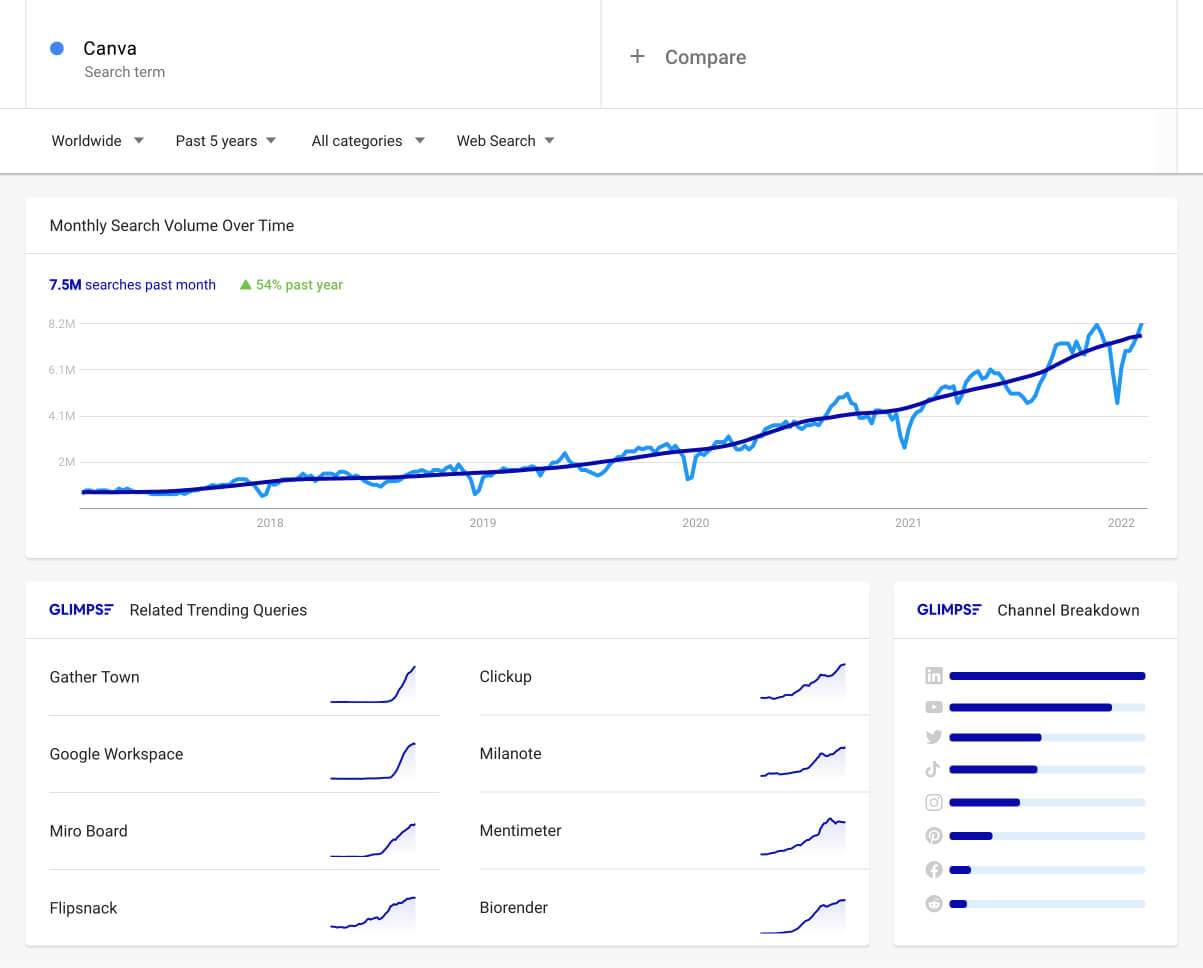
The platform layers directly over Google Trends through a Chrome extension, adding features that should have been there all along:
- Absolute search volume numbers (finally)
- Keyword difficulty scores for SEO planning
- Related trending topics with growth percentages
- Historical data going back 15+ years
At $29/month for the Pro version, it’s essentially Google Trends on steroids. Worth it? If you’re making content decisions based on trend data more than twice a month, absolutely.
2. Exploding Topics: AI-Powered Early Trend Detection
Here’s where things get interesting. Exploding Topics doesn’t wait for trends to become obvious – it catches them at the 2% adoption mark, sometimes 6-12 months before they hit mainstream. The algorithm scans millions of searches and conversations and flags emerging patterns before your competitors notice them.

Think of it like having a time machine for content planning. The platform caught “ChatGPT prompts” trending in October 2022, two months before the mainstream explosion. Early adopters who created content then are still ranking today.
The free version gives you access to trending topics updated weekly. Pro ($39/month) unlocks:
- Custom alerts for your niche
- Growth predictions with confidence scores
- Meta trends (trends about trends)
- API access for automated monitoring
Does it replace Google Trends entirely? Not quite. But for spotting opportunities before they’re obvious, nothing else comes close.
3. Semrush Keyword Overview: Enterprise SEO with Trend Analysis
Semrush isn’t just a google trends alternative – it’s an entire intelligence operation. While Google Trends shows you what’s happening, Semrush tells you why it matters and what to do about it. The Keyword Overview tool tracks search volume fluctuations across 142 geographic databases.
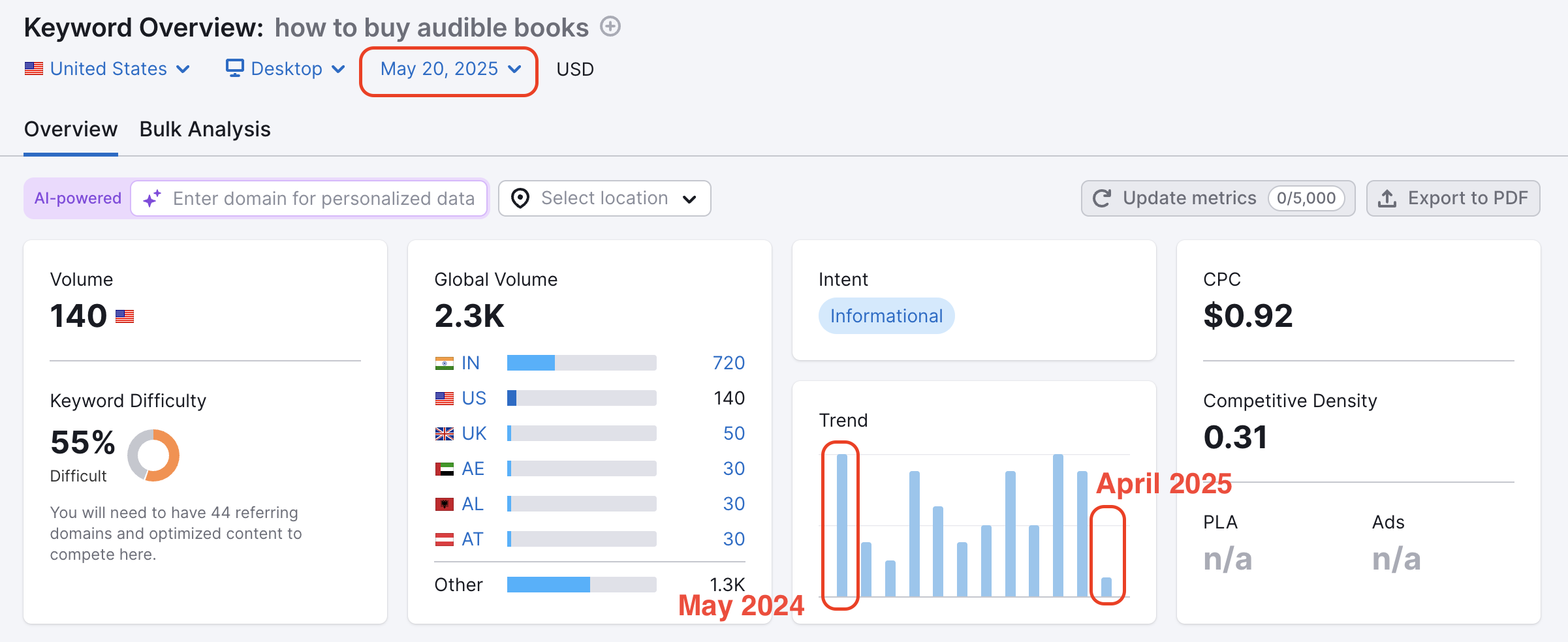
What sets it apart is the competitive context. You see not just the trend line, but who’s ranking for those terms and how difficult it’ll be to compete. The platform shows you:
| Feature | What It Reveals |
|---|---|
| Trend Graph | 12-month search volume patterns with seasonal dips |
| SERP Analysis | Top 100 results with domain authority scores |
| Keyword Variations | Related terms with individual trend data |
| Question Keywords | Rising “how to” and “what is” queries |
Starting at $139/month, it’s not cheap. However, if you’re managing multiple clients or a substantial content operation, the ROI typically becomes apparent within the first campaign.
4. Treendly: Multi-Platform Trend Prediction Engine
Treendly takes a unique approach by aggregating trend data from Google, Twitter, Pinterest, YouTube, and news outlets in one dashboard. The result? You spot cross-platform trends that single-source tools miss completely.
The platform’s strength lies in its prediction algorithm. It doesn’t just show current trends – it forecasts where they’re heading with surprisingly accurate probability scores. Last December, it gave “AI avatars” a 78% chance of explosive growth by March. It was right.
What you get with the Pro plan ($15/month – the most affordable option here):
- 5,000+ trending topics updated hourly
- Custom watchlists with email alerts
- Historical trend data going back 5 years
- CSV exports for deeper analysis
The interface feels a bit dated compared to Semrush or Glimpse. But at this price point with this much data? Hard to complain.
5. BuzzSumo: Social Content Performance Analytics
BuzzSumo attacks the trend problem from a different angle – social proof. Instead of search data, it tracks what content is actually getting shared and engaged with across Facebook and Twitter and LinkedIn and Reddit. Sometimes social trends lead search trends by weeks.
The Question Analyzer feature is particularly powerful for content creators. It monitors forums like Quora and Reddit for rising questions in your niche. When you see the same question popping up 50 times this week versus 5 times last month, you’ve found your next article topic.
Key capabilities that make it one of the best alternatives to Google Trends:
- Content performance tracking across all major platforms
- Influencer identification for trend amplification
- Competitor content monitoring
- Backlink analysis for trending articles
Pricing starts at $199/month. Expensive? Yes. But one viral piece of content can pay for a year’s subscription.
6. Trend Hunter: Cultural Trend Intelligence for Macro Shifts
If Google Trends helps you understand search behaviour, Trend Hunter helps you understand human behaviour, the deep cultural undercurrents that eventually spill over into search demand. This isn’t your typical keyword tool. It’s a full-scale consumer insight engine powered by global researchers and AI.
Trend Hunter scans millions of data points across fashion, tech, media, CPG, design, food, retail, and lifestyle to map macro trends, micro trends, and consumer motivations. If you plan content calendars, campaigns, or quarterly strategies, this is where you get the big-picture signals before they show up anywhere else.
Here’s what makes Trend Hunter powerful:
Consumer behaviour analysis that explains why trends rise
Trend clusters with strength, acceleration, and longevity scores
Industry-specific reports across 30+ verticals
A massive human + AI trend-spotting network
Enterprise tools for forecasting and strategic planning
This tool won’t show you monthly search volume, but it will tell you what people will start searching six months from now.
Pricing starts around $199/month, depending on access level. For serious strategists and brand teams, it’s worth every rupee.
7. Pinterest Trends: Visual Trends 30–60 Days Before Google
Most marketers completely underestimate Pinterest. Huge mistake.
Pinterest Trends consistently predicts Google search behaviour weeks to months in advance because people explore visual ideas before they type them into search.
If you’re in lifestyle, beauty, home décor, travel, food, wellness, parenting, fashion, gifting, weddings, or events, Pinterest outperforms every other trend tool in early detection.
Pinterest Trends gives you:
Real search volume (not relative scoring)
Seasonal trend curves mapped over the years
Breakout keywords experiencing sudden surges
Demographic and audience interest breakdowns
Related Pins that reveal adjacent intent (gold for SEO)
This platform is especially strong for:
Home décor (45–90 days early)
Fashion (30–60 days early)
Recipes & food (4–6 weeks early)
Beauty (20–40 days early)
Events & gifting (months early)
DIY, crafts, kids, parenting content
And the best part?
It’s completely free.
If you want early indicators before Google Trends even wakes up, Pinterest is your silent competitive advantage.
8. Reddit: Real-Time Conversation Signals and Emerging Topic Discovery
Reddit isn’t a keyword tool, it’s a human-insight engine.
If Google shows you “what’s trending,” Reddit shows you why it’s trending, long before the search graph moves.
Reddit is where people vent, ask questions, experiment, complain, discover, compare, review, and share raw opinions. This makes it one of the most accurate early-trend detectors for pain points, new behaviours, and emerging interest spikes.
What Reddit gives you:
Unfiltered questions that reveal rising keyword themes
Conversation frequency spikes (a key demand signal)
Sentiment and language patterns are impossible to get from search tools
Emerging topics in niche communities before they hit mainstream
Subreddits dedicated to tech, AI, marketing, SaaS, beauty, finance, crypto, health, education, and more
Use cases marketers love:
Spotting new products/tools people rave about
Catching early complaints → which become SEO opportunities
Seeing which questions repeat 20–30 times in a week
Identifying user language for more natural content
Finding trend “heat zones” within communities
Reddit is free, though you can enhance data with tools like Subreddit Stats or GummySearch.
No search volume graphs. No dashboards.
Just real humans revealing early signals before any platform quantifies them.
Comparison Table: Best Google Trends Alternatives (All 8 Tools)
| Tool | Key Features | Pricing (Monthly) | Drawbacks |
|---|---|---|---|
| Glimpse | • Exact monthly search volumes • Keyword difficulty & growth metrics • Adds missing features directly into Google Trends • 15+ years of historical data | $29 (Pro) | Works only via Chrome extension; limited standalone dashboard |
| Exploding Topics | • Detects trends at 2–5% adoption • AI-driven early trend detection • Weekly trend reports • Growth predictions & niche alerts | Free / $39 (Pro) | Limited historical depth; no keyword difficulty data |
| Semrush Keyword Overview | • 142-country search databases • SERP + competition analysis • Seasonal search patterns • Keyword clusters & variations | $139 (Pro) | Expensive; learning curve for beginners |
| Treendly | • Multi-platform trend aggregation (Google, YouTube, Pinterest, Twitter, News) • Predictive trend scores • 5,000+ topics updated hourly • Custom watchlists + CSV export | $15 (Pro) | UI feels outdated; smaller dataset compared to premium tools |
| BuzzSumo | • Social media trend tracking • Influencer identification • Competitor content monitoring • Question Analyzer (Reddit + Quora) | $199 (Pro) | High cost; limited search-volume insights |
| Trend Hunter | • Cultural + macro trend intelligence • Human + AI trend spotter network • Trend clusters with longevity scores • Industry-specific reports | Starting ~ $199 | Not designed for SEO; no search-volume metrics |
| Pinterest Trends | • Real search volume • Seasonal curves & breakout keywords • Early visual trend signals (30–90 days ahead) • Demographic insights | Free | Limited to Pinterest ecosystem; strongest only for visual/lifestyle niches |
| • Real-time community signals • Unfiltered questions revealing early demand • Sentiment + behavioural trends • Niche discovery across thousands of subreddits | Free | No search-volume data; requires manual analysis or third-party tools |
Implementing Alternative Platforms for Strategic Analysis
Having the tools is one thing. Using them strategically is what separates the pros from everyone else, refreshing Google Trends, hoping for inspiration.
Combining Multiple Data Sources for Comprehensive Insights
Relying on a single trend platform is like trying to understand a 3D object by looking at its shadow. You need multiple angles to see the full picture. The most successful content strategists layer their research:
The most successful content strategists layer their research:
Start with Exploding Topics to spot emerging opportunities early.
Validate actual search volume using Glimpse.
Check visual and seasonal intent using Pinterest Trends.
Scan Reddit to understand real user conversations and pain points.
Use BuzzSumo to confirm whether the topic has social momentum.
Then use Semrush to assess the competitive landscape and ranking difficulty.
For long-term strategy, refer to Trend Hunter to understand macro shifts influencing the trend.
This multi-source validation process takes about 20 minutes and prevents you from chasing phantom trends.
Smart marketers create a trend validation checklist:
- ✓ Search volume growing for 3+ consecutive months
- ✓ Social engagement is increasing across 2+ platforms
- ✓ Visual demand rising on Pinterest (optional but powerful)
- ✓ Conversations increasing on Reddit (topics repeating 20–30 times)
- ✓ Competitor content gap exists (fewer than 5 strong articles)
- ✓ Commercial intent present (people asking “best” or “how to”)
- ✓ Your expertise aligns with the topic
Hit 4 out of 5? You’ve found your next content winner.
Setting Up Custom Alerts and Monitoring Systems
The biggest mistake people make with trend tools? Checking them randomly when they remember. Set up systematic monitoring, or you’re just gambling.
Create a three-tier alert system. Critical alerts (your brand terms and core topics) should ping you immediately through Slack or email. Secondary alerts (competitor movements and adjacent topics) can be weekly digests. Exploration alerts (wild cards and experimental keywords) work best as monthly reports.
Most platforms offer RSS feeds or API access. Connect these to Zapier or Make.com to automate your workflow. When Treendly spots a trend matching your criteria, it can automatically create a content brief in your project management tool. That 5-minute setup saves hours of manual checking.
Integrating Trend Data with Content Strategy
Trend data without action is just expensive entertainment. Build a systematic process for turning insights into published content. The fastest publishers win the organic traffic lottery.
Here’s the framework that works: Monitor trends daily (5 minutes). Review weekly for content opportunities (30 minutes). Plan monthly based on validated trends (2 hours). This 70/20/10 approach keeps you responsive without being reactive.
Create content templates for different trend types:
| Trend Type | Content Format | Publish Timeline |
|---|---|---|
| Breaking News | Quick take (500-800 words) | Same day |
| Rising Topic | Comprehensive guide (2000+ words) | Within 72 hours |
| Seasonal Trend | Updated resource page | 4 weeks before peak |
| Evergreen Shift | Pillar content refresh | Within 2 weeks |
Maximising ROI Through Platform-Specific Features
Each platform has hidden features most users never touch — and that’s where the real ROI hides.
Glimpse’s Pinterest trend indicators often predict Google search peaks 45–60 days early.
Semrush’s Keyword Gap tool reveals trending keywords your competitors already rank for.
BuzzSumo’s Chrome extension surfaces share counts directly in Google results.
Pinterest Trends gives seasonal demand curves and breakout keywords months before search volume rises.
Reddit exposes early pain points through repeated questions — gold for long-tail keyword content.
Trend Hunter provides macro trend clusters for long-term campaigns and evergreen content planning.
Treendly’s prediction scores help you avoid wasting time on short-lived trends.
Exploding Topics newsletters often spark viral content opportunities weeks ahead.
Track your tool ROI religiously. If a $39/month subscription helps you publish one blog that brings in 1,000 visitors monthly, that’s a 25x return. Most marketers never do this math. Don’t be most marketers.
Choosing the Right Google Trends Alternative for Your Needs
After testing these platforms extensively (and burning through more trial subscriptions than I’d like to admit), here’s the truth: there’s no single best google trends alternative. Your choice depends on what you’re actually trying to accomplish.
Need real search volume + SEO planning?
→ Choose GlimpseWant to spot trends before the world notices?
→ Choose Exploding TopicsNeed competitive intelligence + data depth?
→ Choose SemrushWant to see which content actually resonates socially?
→ Choose BuzzSumoWant multi-platform aggregation on a budget?
→ Choose TreendlyNeed visual/seasonal demand forecasting?
→ Choose Pinterest TrendsWant to understand cultural shifts for long-term strategy?
→ Choose Trend HunterWant raw, real-time insights from actual user conversations?
→ Choose Reddit
Start with one paid tool that matches your primary need, then supplement with free alternatives. Most successful marketing teams use 2-3 tools in combination. The investment typically pays for itself within the first successful campaign.
The platforms that help you track search trends without Google Trends aren’t just nice-to-haves anymore. They’re the difference between riding waves and constantly playing catch-up. Pick your tools, set up your systems, and start surfacing insights your competitors won’t see for months.
FAQs
1. Which free alternatives to Google Trends are most reliable?
Exploding Topics (free tier) gives weekly trend updates, Treendly offers basic multi-platform insights, Pinterest Trends is completely free and great for early visual signals, and Reddit is useful for spotting rising questions and discussions. Keyword Surfer also shows free search volumes inside Google.
2. How do paid platforms compare in pricing and features?
Treendly is the cheapest ($15/month). Glimpse ($29) enhances Google Trends with real volume data. Exploding Topics ($39) excels at early detection. Semrush ($139) offers deep SEO data. BuzzSumo ($199) leads in social insights. Trend Hunter (starts ~ $199) focuses on macro and cultural trends.
3. Can these tools predict future trends accurately?
Exploding Topics predicts early trends with good accuracy, Treendly provides short-term forecasts, and Pinterest Trends often predicts seasonal demand before Google does. Reddit isn’t predictive, but rising conversations signal upcoming search interest.
4. What’s the best alternative for YouTube or social trends?
BuzzSumo for overall social platforms. VidIQ and TubeBuddy for YouTube. Pinterest Trends for visual topics. Reddit for early user discussions and content ideas.
5. How often should I monitor trends?
Daily (5 minutes) for quick checks, weekly (30 minutes) for patterns, and monthly (1–2 hours) for strategy. Use alerts across multiple tools to stay consistent.

Ridam Khare is an SEO strategist with 7+ years of experience specializing in AI-driven content creation. He helps businesses scale high-quality blogs that rank, engage, and convert.