

Every SEO expert seems to have the same playbook: optimize your title tags, build more backlinks, and stuff in those keywords. Following this advice blindly is exactly why most websites stay buried on page three of Google. The real killers of your rankings aren’t what the gurus talk about – they’re the subtle mistakes that compound over time and slowly strangle your visibility.
10 Common SEO Mistakes That Hurt Your Rankings
1. Ignoring Search Intent in Your Content
Picture this: someone searches for “best running shoes” and lands on your 3,000-word history of Nike. They’ll bounce faster than you can say “search intent.” This disconnect between what people want and what you deliver is probably the most expensive mistake you’re making right now.
Search intent breaks down into four buckets: informational (how-to guides), navigational (finding specific sites), commercial (product comparisons), and transactional (ready to buy). Miss the intent, miss the traffic. Simple as that.
If you are trying to grow your qualified search traffic, you have to combine your content marketing with your SEO efforts. — Neil Patel
2. Keyword Stuffing and Unnatural Language
Here’s what drives me crazy – websites that read like they were written by a robot having a seizure. You know the type: “Our SEO services provide the best SEO services for businesses looking for SEO services.” Google’s algorithm can smell this desperation from a mile away, and it’s not impressed.
Natural language wins every time. Your keywords should flow like conversation, not stick out like a sore thumb.
3. Publishing Duplicate or Thin Content
Thin content is like serving your guests crackers and calling it dinner. Those 200-word service pages you cranked out in 2019? They’re dead weight. Google wants substance, depth, and actual value – not filler that says nothing in three paragraphs.
Duplicate content is even worse. It confuses search engines and dilutes your authority across multiple pages fighting for the same terms.
4. Poor Mobile Optimization and Slow Loading Speed
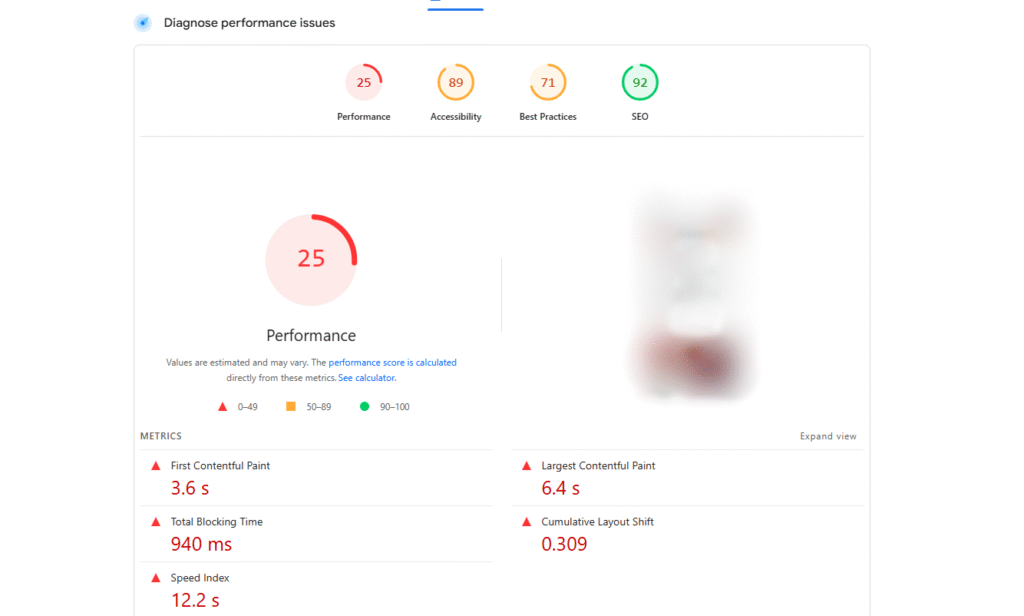
Your site takes 8 seconds to load on mobile. Know what happens in those 8 seconds? Your visitor has already clicked back and chosen your competitor. Mobile-first indexing isn’t coming – it’s been here since 2019, and if you’re still treating mobile as an afterthought, you’re hemorrhaging traffic.
Speed matters more than ever. Every second of load time costs you conversions and rankings.
5. Missing or Poorly Optimized Meta Tags
Meta descriptions don’t directly impact rankings (shocking, right?), but they’re your sales pitch in the search results. A compelling meta description can double your click-through rate. A missing one lets Google write it for you – usually pulling some random snippet that makes zero sense out of context.
6. Neglecting Internal Linking Structure
Internal links are the highways of your website. Without them, you’ve built a city with no roads. Your best content sits isolated on page 47 of your blog archive while your homepage gets all the link juice. Smart internal linking distributes authority and keeps visitors exploring. Most sites leave this gold mine completely untapped.
7. Not Tracking Keywords and ROI Properly
Flying blind without proper tracking is like trying to lose weight without ever stepping on a scale. You need to know your baseline rankings and track movement week by week and month by month and see what’s actually driving revenue. Most businesses track vanity metrics while missing the keywords that actually pay the bills.
Set up proper conversion tracking. Now.
8. Skipping Image Optimization and Alt Text
That beautiful hero image on your homepage? It’s 5MB and crushing your Core Web Vitals. Image optimization isn’t sexy, but those milliseconds add up fast. Plus, alt text isn’t just for accessibility (though that should be reason enough) – it’s free real estate for relevant keywords.
9. Creating Service Pages Without Focus
Service pages that try to rank for everything end up ranking for nothing. “We do web design and SEO and social media and email marketing and…” Stop. Each service needs its own focused page with specific keywords, unique value propositions, and targeted content. One page, one purpose.
10. Ignoring Core Web Vitals and Technical SEO
Core Web Vitals – LCP, FID, CLS (yeah, the acronyms nobody remembers) – are now ranking factors. Your beautiful design means nothing if it shifts around while loading, making people click the wrong button. Technical SEO might be boring, but it’s the foundation everything else builds on.
How to Fix These SEO Mistakes
Align Content with User Search Intent
Start by actually searching your target keywords. Look at the top 3 results. Are they blog posts? Product pages? Comparison guides? That’s your template. Match the format and depth of what’s already winning, then make it 10% better with your unique insights.
“The best place to hide a dead body is page 2 of Google search results”
But seriously, understanding intent transforms your content strategy from guesswork to science.
Write Naturally While Including Keywords
Forget keyword density percentages. Write for humans first, then sprinkle in your keywords where they fit naturally. Read your content out loud – if it sounds weird, it is weird. Your primary keyword should appear in your title, first paragraph, and a couple of subheadings. Everything else should flow naturally.
| DON’T | DO |
| Our SEO services provide SEO solutions for SEO needs | We help businesses rank higher and drive more organic traffic |
| Keyword, keyword everywhere | Natural variations and related terms |
Create Unique Value-Driven Content
Value beats volume every single time. One comprehensive 2,000-word guide that actually solves problems will outperform ten 300-word fluff pieces. Include original research, case studies, expert quotes – anything that can’t be found on your competitor’s site.
What’s your unique angle? Find it and own it.
Implement Responsive Design and Speed Optimization
Mobile optimization isn’t optional anymore. Your site should look good on everything from an iPhone 6 to a tablet to a desktop monitor. Use responsive design, compress those images (seriously, WebP format can cut file sizes by 30%), and eliminate render-blocking resources.
- Test your site on actual mobile devices, not just browser dev tools
- Aim for under 3-second load times on 3G connections
- Use lazy loading for images below the fold
- Minify CSS and JavaScript files
- Enable browser caching
Craft Compelling Meta Titles and Descriptions
Your meta title has about 60 characters to convince someone to click. Your meta description gets 155. Make them count. Include your primary keyword naturally, add a benefit or urgency trigger, and write like you’re crafting a PPC ad – because essentially, you are.
Test different approaches. Track CTR in Search Console. Iterate based on what works.
Stop Making These SEO Mistakes Today
Most of these common SEO mistakes can be fixed in an afternoon. The question isn’t whether you have time – it’s whether you can afford to keep bleeding traffic to competitors who’ve already fixed theirs. Start with the quick wins: optimize your images, fix your meta tags, and speed up your site.
The bigger fixes – content alignment, internal linking, Core Web Vitals – those take time but pay dividends for years. Pick one mistake from this list and fix it this week. Then move to the next. Small improvements compound into massive results.
SEO isn’t about perfection. It’s about being slightly better than your competition in the areas that matter most. Now stop reading and start fixing.
FAQs
What is the biggest SEO mistake in 2025?
Ignoring search intent tops the list. You can have perfect technical SEO and still fail if your content doesn’t match what searchers actually want. Close second? Not optimizing for mobile-first indexing when 60% of searches happen on mobile devices.
How do I know if my site has duplicate content issues?
Run a site crawl with Screaming Frog or similar tools. Look for multiple URLs with identical or near-identical title tags and meta descriptions. Also check Google Search Console for “Duplicate without user-selected canonical” warnings – that’s Google telling you there’s a problem.
Why is mobile-first indexing important for SEO?
Google primarily uses your mobile version for indexing and ranking. If your mobile site is broken or missing content, that’s what Google judges you on – even for desktop searches. It’s not about mobile traffic percentages anymore; it’s about how Google sees your entire site.
How often should I update my old content?
Review your top-performing content quarterly and update anything that’s outdated or declining in traffic. For evergreen content, a yearly refresh keeps it relevant. Add new sections, update statistics, and improve based on new competing content. Fresh content gets a rankings boost.
Can keyword stuffing still work in 2025?
Absolutely not. Google’s AI understands context and synonyms better than ever. Keyword stuffing now triggers spam filters and tanks your rankings. Focus on topic relevance and natural language – Google knows what you’re talking about without you repeating the same phrase 20 times.

Ridam Khare is an SEO strategist with 7+ years of experience specializing in AI-driven content creation. He helps businesses scale high-quality blogs that rank, engage, and convert.