
The second week of November brought updates that show how quickly search is shifting across both Google and Microsoft. From Google clarifying core technical SEO practices to new AI tools sparking debate, and multilingual content emerging as a surprising advantage in AI Overviews, the week highlighted major changes in how search engines interpret, generate, and attribute content.
Google also introduced new shipping and returns options in Search Console, reducing reliance on Merchant Center for e-commerce visibility. Together, these developments reinforce a landscape where AI behaviour, structured data, content quality, and transparent citations matter more than ever.
Here are the key updates from the week and what they mean for SEO teams moving forward.
1. Google Opal: AI Tool Designed for “Optimised Content at Scale”
What happened:
Google’s internal AI tool “Opal” is being promoted as a way to instantly generate blog posts, captions, and content recommendations at scale. This raised eyebrows because Google simultaneously warns SEOs about scaled content abuse.
This laughs in the face of a lot of Google’s own teams that, for decades, fought spam and abuse in search. https://t.co/cNp2SR23Ee
— Pedro Dias (@pedrodias) November 9, 2025
Why it matters:
This contradiction has confused the SEO community, Google discourages mass AI content generation but is developing tools that do exactly that. It suggests Google expects quality-checked, human-edited AI content, not raw automation.
What to do:
- Use AI tools to assist, not replace human expertise.
- Add original insights, fact-checks, and first-hand experience.
- Avoid generating hundreds of AI pages quickly, it may trigger spam classifiers.
2. Microsoft Copilot Gets Major AI Search Upgrade With Better Citations
What happened:
Microsoft upgraded Copilot’s search feature to include richer citations, exposed source links, and aggregated reference lists. This makes Copilot function more like a transparent AI search engine rather than a conversational black box.
More details today about how we’re enhancing search within Copilot. Besides more prominent citations, you can get all the relevant search results clicking “Show all." We’ve also optimized the prompt to search more effectively which significantly improves the chat responses. In… pic.twitter.com/UKSZ3Pi0pV
— Jordi Ribas (@JordiRib1) November 7, 2025
Why it matters:
This is a shift toward AI systems that send traffic back to publishers. Unlike some Google AI Overviews, Copilot now clearly exposes where information comes from.
What to do:
- Optimise content for AI extraction and summarisation.
- Strengthen credibility signals so Copilot is more likely to cite your site.
- Track traffic from Bing/Copilot, it may grow over the next year.
3. Google Confirms: Structured Data Mark-Up Is NOT Being Removed
What happened:
Rumours circulated that Google planned to pull back on structured data support. Google clarified this is false, schema remains important, though individual schema types may be deprecated occasionally.
The Reddit thread asked:
Google just posted a new update — they’re removing support for some structured data types starting in January 2026. Dataset already works only in Dataset Search, and rich results are getting more selective.
So… is schema still worth it? Or are we moving past it entirely?
John Mueller from Google replied:
Exactly. Understand that markup types come and go, but a precious few you should hold on to (like title, and meta robots).
This was in response to the following response:
The structured data they use is always in flux. They drop and add search features all the time that may or may not rely on structured data. I very much doubt it is going away. The best thing to do is monitor the Google developers articles on search features and utilize the schema that will make it easier for Google to parse your content.
John also said, “Love this comparison” to the following commment posted on Reddit:
When you go to the hair dressers and let them “cut an inch off at the end”, are you going bald after that or are you improving your hair?
Why it matters:
Structured data continues to fuel rich results, AI overviews, and entity recognition. Schema continues to be a foundational pillar for technical SEO.
What to do:
- Continue implementing schema across all key pages.
- Validate markup via Search Console or schema testing tools.
- Remove outdated or deprecated schema types.
4. Multilingual Sites See +327% Higher Visibility in AI Overviews
What happened:
A new study by Weglot shows that websites with translated versions of their content see dramatically higher inclusion rates in Google’s AI Overviews and ChatGPT, resulting in up to a 327% visibility increase.
Why it matters:
AI systems want broader knowledge coverage. Multilingual content helps Google & LLM bots understand your brand better and gives AI Overviews & chat bots more confidence to cite you.
What to do:
- Translate priority pages into 2–3 key languages.
- Add proper hreflang tags.
- Localise, don’t just machine-translate.
5. Google Search Console Adds Shipping & Returns Support Without Merchant Center
What happened:
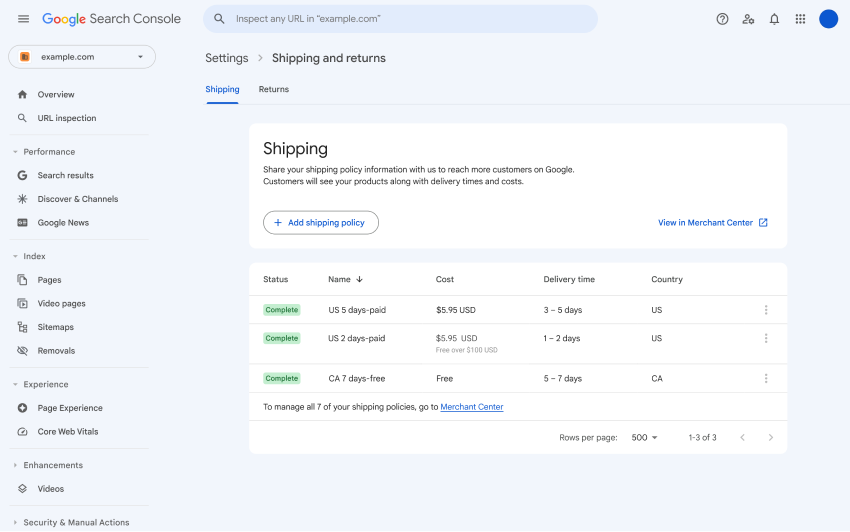
Google now lets merchants add shipping and returns details directly in Search Console, even without a Merchant Center account. A new organisation-level shipping policy schema was also introduced, and any settings in Search Console override site markup.
Why it matters:
This makes fulfillment info easier to manage and helps stores display clearer, more trusted policies in Search results, improving user confidence and product visibility.
What to do:
- Add policies under Search Console → Settings → Shipping & Returns.
- Use the new organisation-level schema if adding markup.
- Ensure your on-site policy pages match what you submit.
This divergence will influence content strategy in 2026 and beyond.

Ridam Khare is an SEO strategist with 7+ years of experience specializing in AI-driven content creation. He helps businesses scale high-quality blogs that rank, engage, and convert.