Most ecommerce sites treat internal links like an afterthought – a few breadcrumbs here, some footer links there, maybe a related products section if someone remembers. Meanwhile, Amazon generates billions in extra revenue from their internal linking architecture alone. The difference isn’t budget or technology. It’s understanding that ecommerce internal linking works like the aisles in a physical store – guide customers wrong and they leave empty-handed.
What Are Internal Links?
Internal links connect pages within your own website. Think of them as hallways in your store. Every link from one product to another, from a category page to a subcategory, from your homepage to anywhere else on your site – those are all internal links. They tell both customers and search engines how your store is organized and which pages matter most.
The real magic happens when you realize these links pass “link equity” – basically SEO juice – throughout your site. A strong product page can boost weaker ones just by linking to them strategically. It’s like having your bestsellers vouch for your new arrivals.
Why Are Internal Links Important for E-commerce SEO?
Picture this: Google’s crawler arrives at your homepage with limited time to explore your site. Without proper internal linking, it might index 100 pages and miss your 500 bestsellers hiding in the depths of your catalog. That’s revenue sitting in the dark.
But here’s what drives most store owners crazy – you spend thousands on backlinks and content marketing, then wonder why certain products never rank. Nine times out of ten, those products are orphaned. No internal links point to them. Google can’t find what you don’t connect.
Beyond SEO, internal links directly impact your conversion rates. When someone lands on a product page, strategic links to complementary items can turn a $50 sale into a $150 cart. Your internal linking strategies for online stores literally shape the customer journey.
Step-by-Step Process to Implement Ecommerce Internal Linking
1. Audit Your Current Internal Link Structure
Start by finding your orphaned pages. Run a crawl with Screaming Frog or Sitebulb (both have free versions that handle up to 500 URLs). Export the list of pages with zero internal links pointing to them. These are your quick wins.
Next, identify your power pages – the ones with the most external backlinks. Use Ahrefs or even Google Search Console for this. These pages have link equity to spare. You’ll use them as distribution hubs later.
Check your click depth too. If customers need more than three clicks to reach a product from your homepage, you’re hemorrhaging both SEO value and sales. Amazon keeps 90% of their products within three clicks. There’s a reason.
2. Create Category Page Link Hierarchies
Your category pages should work like a pyramid. Main categories link to subcategories, subcategories link to product listings, and everything flows both ways. Sounds simple, right?
Here’s where most stores mess up – they create category pages but forget to link between related categories. If you sell running shoes, your “Running Shoes” category should link to “Running Shorts” and “Running Accessories.” These contextual connections tell Google these pages are topically related.
Link From | Link To | Anchor Text Example |
|---|---|---|
Main Category | Subcategory | “Shop men’s running shoes” |
Subcategory | Related Subcategory | “Complete your outfit with running shorts” |
Category | Bestselling Product | “Our top-rated Nike Pegasus 40” |
3. Build Product-to-Product Connections
This is where the money lives. Every product page should link to at least 3-5 related products. But don’t just throw random links around. Create logical connections that actually help customers.
Use these linking strategies: • Complementary products: Link running shoes to moisture-wicking socks • Alternative options: Link to similar products at different price points • Upgrade paths: Link basic models to premium versions • Brand collections: Link between products from the same brand
The key? Make these links contextual within product descriptions, not just in a widget. Write something like “Pairs perfectly with our Elite Running Socks for maximum comfort during long runs.”
4. Optimize Footer and Navigation Links
Your header and footer appear on every page. That’s massive linking power most stores waste on links to privacy policies and shipping information. Yes, those pages need links, but they shouldn’t dominate your navigation.
Instead, use your footer for: • Top 10 bestselling categories • Seasonal collections or sale sections • High-margin product lines you want to push • New arrivals that need an SEO boost
Keep your main navigation clean though. Studies show that 7 (+/- 2) menu items is the sweet spot for user experience. More than that and people get paralyzed by choice.
5. Add Contextual Links in Product Descriptions
Most product descriptions read like spec sheets. Boring. Instead, tell a story and weave in natural links to related products. Watch how this works:
“This waterproof jacket kept us dry during a 6-hour downpour in Seattle. The sealed seams and YKK zippers (the same ones used in our Summit Series backpacks) mean zero water gets through. Layer it over our Merino base layers for all-day comfort in wet conditions.”
See how those links feel natural? They add value while guiding customers to complementary products. That’s how to improve ecommerce site navigation without being pushy.
6. Implement Breadcrumb Navigation
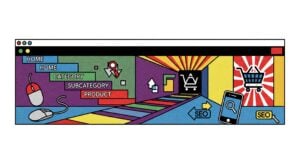
Breadcrumbs are those little navigation trails that show: Home > Category > Subcategory > Product. They seem minor but pack a triple punch – they help users navigate, pass link equity up your site hierarchy, and often appear in search results.
The implementation is straightforward: 1. Add schema markup for breadcrumbs (Google loves this) 2. Keep the trail clickable at every level 3. Use descriptive text, not generic labels 4. Make them prominent on mobile (where back buttons are harder to find)
One weird trick that actually works? Add a “Recently Viewed” breadcrumb section. It’s not technically a breadcrumb but functions the same way and keeps people circulating through your products.
7. Set Up Related Product Sections
Every ecommerce platform has a related products feature. Most stores set it to “random products from the same category” and call it a day. That’s leaving money on the table.
Here’s the hierarchy that actually converts: 1. Frequently bought together (highest conversion rate) 2. Customers also viewed (keeps people browsing) 3. Similar items (alternatives at different price points) 4. Recently viewed (reminds them what caught their eye)
The secret sauce? Manually curate these for your top 20% of products. Let automation handle the long tail, but your bestsellers deserve human attention. A well-curated related products section can increase average order value by 10-30%.
Critical Internal Linking Mistakes to Avoid in Ecommerce
Over-Optimizing Anchor Text
Nothing screams “I read one SEO article in 2015” like having every internal link use exact-match anchor text. If you sell blue widgets and every link says “blue widgets,” Google knows you’re trying to game the system.
Mix it up naturally: • Exact match: “blue widgets” (use sparingly, maybe 20% of links) • Partial match: “affordable blue widgets” • Branded: “WidgetCo’s bestseller” • Generic: “click here” or “learn more” (yes, these have their place) • Naked URL: “widgetstore.com/blue-widgets”
Creating Orphaned Product Pages
Every time you add a product without linking to it from anywhere, you create an orphan. These pages might as well not exist. Google rarely indexes them and customers never find them.
The fix is simple but requires discipline. Create a new product checklist: ✓ Link from relevant category page ✓ Link from at least 3 related products ✓ Add to XML sitemap ✓ Include in internal search results ✓ Mention in a blog post or buying guide
Ignoring Mobile Navigation Structure
Desktop users see your full mega-menu. Mobile users get a hamburger menu that hides everything. If your internal linking strategy relies solely on navigation menus, you’re invisible to most of your traffic.
Mobile needs more in-content links, clearer category pages, and prominent “related products” sections. Test your site on an actual phone (not just dev tools). Can you reach any product in three taps? If not, fix your mobile linking structure.
Using JavaScript-Only Links
Google claims they can crawl JavaScript. Sure, they can. But will they? JavaScript links are like putting your products behind a door that sometimes sticks. Why risk it?
Use standard HTML links whenever possible. If you must use JavaScript for fancy effects, implement it as progressive enhancement – the link works without JavaScript, but JavaScript makes it prettier. Your best internal linking tools for ecommerce should generate clean, crawlable HTML links by default.
Conclusion
Internal linking for ecommerce isn’t just about SEO – though the organic traffic boost is real. It’s about creating a store that makes sense. Every link is a path you’re laying out for customers and search engines alike.
Start with the audit. Find those orphaned pages and connect them. Build logical hierarchies from categories to products. Make your bestsellers work harder by having them link to related items. And please, stop treating your footer like a junk drawer.
The stores crushing it online understand this: ecommerce internal linking is your silent salesperson, working 24/7 to guide customers to what they need and what you want to sell. Master it, and watch both your rankings and revenue climb. This ecommerce internal linking guide 2025 approach focuses on what actually moves the needle – not what sounds good in theory.
Frequently Asked Questions
How many internal links should an ecommerce product page have?
Aim for 5-15 internal links per product page. This includes breadcrumbs (3-4 links), related products (4-6 links), and contextual links in the description (2-5 links). The exact number depends on your product complexity and page length. A simple t-shirt needs fewer links than a complex electronic device with multiple accessories.
What internal linking tools work best for online stores?
For auditing, Screaming Frog SEO Spider catches orphaned pages and visualizes your link structure. Link Whisper (WordPress) automates smart internal link suggestions. For Shopify stores, Smart SEO or Plug in SEO handle the basics well. But honestly? A simple spreadsheet tracking your top products and their internal links beats any fancy tool if you stay consistent.
Should I link between competing products on my ecommerce site?
Absolutely. Linking between similar products at different price points actually increases conversions. Customers want to compare options. Give them an easy path to do it on your site, or they’ll open a new tab and potentially buy from a competitor. Just frame it right – “Looking for a more affordable option?” or “Want additional features?”
How do internal links impact ecommerce conversion rates?
Strategic internal linking can boost conversions by 20-40% through better product discovery. Related product sections alone typically increase average order value by 10-30%. The impact multiplies when you nail the user intent – someone viewing running shoes who sees links to running socks is way more likely to add both to cart than if they had to search for socks separately.

Ridam Khare is an SEO strategist with 7+ years of experience specializing in AI-driven content creation. He helps businesses scale high-quality blogs that rank, engage, and convert.