

Most ecommerce guides tell you to stuff your site with keywords and watch the sales roll in. That strategy worked great in 2010 — not anymore. If you want the bigger picture, start with the complete ecommerce SEO framework so your keyword strategy sits on a solid foundation. Today, the old keyword-stuffing approach is the fastest way to tank your conversion rates while Google quietly pushes your store to page five where nobody will ever find it.
The real game has shifted. Smart ecommerce keyword research isn’t about finding the most searches – it’s about finding the right searches at the exact moment someone’s credit card is already halfway out of their wallet. You need keywords that signal buying intent, not just browsing interest. Think “waterproof hiking boots size 11” versus “best hiking boots” – one query has a shopping cart waiting, the other has a blog reader killing time.
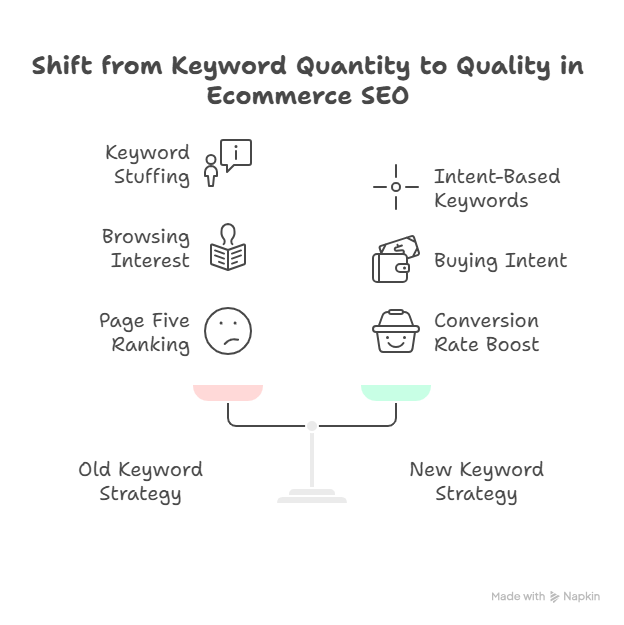
Here’s what actually moves the needle: understanding the difference between someone researching and someone ready to buy and using strategic ecommerce linking patterns to guide each searcher to the right page, then building your entire keyword strategy around that distinction. Let me show you exactly how the pros do it.
Building Your Ecommerce Keyword Research Checklist
You know that overwhelming feeling when you open a keyword tool and see 10,000 potential keywords staring back at you? Most store owners freeze right there. They export everything to a spreadsheet and never look at it again. (I’ve got three of those spreadsheets from 2019 still sitting in my Google Drive, untouched.)
Here’s a better way – a systematic ecommerce keyword research checklist that actually gets implemented:
1. Start with Seed Keywords
Forget what the tools tell you initially. Open your actual sales data first. Look at your top 10 best-selling products and write down exactly how YOU would search for them. Not industry terms, not manufacturer codes – the actual words you’d type at 11 PM when you need something delivered by Thursday.
Your seed keywords should come from three places: your product names stripped of brand jargon, the problems your products solve (not features), and the exact phrases from your customer service emails when people describe what they’re looking for. That last one is gold – customers literally hand you their search terms.
2. Analyze Search Volume and Competition
Here’s where most guides get it wrong. They tell you to chase high-volume keywords. But a keyword with 50,000 monthly searches and Amazon, Walmart, and Target on page one? You’re toast.
The sweet spot for most ecommerce sites sits between 500-5,000 monthly searches. Enough traffic to matter, not enough for the giants to care. Look for that magic combination: decent volume, commercial intent, and at least two spots on page one occupied by sites with lower domain authority than yours.
3. Evaluate Keyword Difficulty Scores
Keyword difficulty scores are useful but misleading. A KD of 30 might be impossible if you’re selling electronics (hello, Best Buy), but totally achievable if you’re in vintage fountain pens. Context matters more than the number.
Instead of obsessing over KD scores, do this: Google your target keyword and honestly ask yourself if your product page would look out of place in those results. Can you create something definitively better than what’s ranking in position 5? That’s your real difficulty score.
4. Map Keywords to Buyer Intent Stages
Stop treating all keywords equally. They’re not. Someone searching “coffee maker reviews” needs education. Someone searching “Breville Barista Express BES870XL price” needs a checkout button. Mix these up and you’ll frustrate everyone.
| Intent Stage | Keyword Examples | Page Type |
|---|---|---|
| Research | “how to choose…” “best… for…” | Blog/Guide |
| Comparison | “vs” “alternatives to” “reviews” | Comparison Page |
| Purchase | model numbers, “buy” “price” “deal” | Product Page |
5. Categorize by Product Pages vs Blog Content
Your product pages and blog content need completely different keyword strategies. Product pages should target transactional keywords – the ones with buying signals and follow a solid product page optimisation approach. Blog content captures the research phase and builds trust before the sale.
Product pages win with specificity: exact model names, SKUs with common misspellings (yes, really), and feature-specific searches. Blog content wins with problems: “how to stop coffee from tasting bitter” leads to your burr grinder collection eventually. Map each keyword to its natural home. Don’t force it.
6. Track Seasonal Search Trends
That keyword with 10,000 monthly searches? Dig deeper. You might find 9,000 of those searches happen in December. Seasonal keywords can make or break your quarter, but only if you start ranking for them three months before everyone starts searching.
Pull up Google Trends for your top 20 keywords. Look for patterns. Start your content push 60-90 days before the spike. By the time demand peaks, you’ll be sitting pretty on page one while your competitors scramble to create content that won’t rank until next year.
Top Ecommerce Keyword Research Tools and Techniques
Let’s be honest – everyone uses the same five tools. The difference isn’t the tool. It’s knowing which data to ignore. Most of these platforms throw 47 different metrics at you, but only three or four actually impact your bottom line.
1. Semrush for Comprehensive Keyword Analytics
Semrush excels at one thing above all: showing you exactly what’s working for your competitors. Skip the fancy features. Go straight to the Organic Research tool, plug in your top three competitors, and filter for keywords where they ALL rank but you don’t. That gap? That’s your opportunity list.
The Keyword Magic Tool gets all the attention, but the real goldmine is Position Tracking. Set up your core commercial keywords and watch them daily. The moment a competitor drops, you pounce. I’ve seen single keyword movements worth five figures in monthly revenue.
2. Ahrefs Keyword Explorer Features
Ahrefs tells you things other tools won’t. Their “Parent Topic” feature alone will save you from creating 15 different pages for basically the same keyword. But here’s the feature nobody talks about: Traffic Potential. Forget search volume – this shows actual traffic the #1 result gets. Sometimes it’s 10x the search volume. Sometimes it’s barely anything. That disconnect reveals everything about user intent.
3. Google Keyword Planner Essentials
Everyone dismisses Keyword Planner as basic. They’re wrong. It’s the only tool showing you exactly what Google thinks about commercial intent – just look at the suggested bid prices. A keyword with 1,000 searches and a $0.50 suggested bid? Skip it. A keyword with 100 searches and a $15 bid? That’s where the money is.
What really matters: use exact match types, always pull 24 months of data to spot trends, and pay attention to the “Competition” column – it’s talking about ad competition, but high ad competition usually means high commercial value.
4. Keyword Tool.io for Multi-Platform Research
This tool does one thing brilliantly: it shows you what people search for on Amazon, YouTube, and eBay. Your customers don’t just live on Google. Those Amazon autocomplete suggestions? They’re based on actual purchase behavior, not just searches. Mine those for product page optimization that converts.
5. SpyFu for Competitor Analysis
SpyFu shows you your competitors’ paid keywords going back years. Here’s why that matters for organic: if they’ve been paying for a keyword consistently for 12+ months, it converts. Period. Build your organic strategy around keywords with proven commercial value – let them pay to validate demand while you rank organically.
6. Long-Tail Keyword Discovery Methods
Stop generating long-tail keywords. Start stealing them. Go to your Google Search Console, filter for queries with impressions but less than 3% CTR, and sort by impressions. These are long-tail keywords Google already associates with your site but you’re not targeting properly. Create focused content for these and watch your traffic jump 20-30% in 60 days.
The manual method that always works: type your main keyword into Google and scroll to the “People also ask” section. Click each question to expand more questions. Do this 5-6 times. You just uncovered the entire question funnel around your topic – each one is a long-tail keyword opportunity.
7. Commercial Intent Keywords Identification
Commercial intent hides in small words. “Best” means research. “Buy” means transaction. But “coupon,” “discount,” “deal,” “price,” “shipping” – these modifiers signal wallets opening. Layer these with your product terms for keywords that convert at 2-3x your site average.
Don’t overlook the awkward phrases either. “Where to buy [product] near me” or “[product] free shipping” might sound clunky, but they print money. These searchers have already decided to buy – they’re just choosing where.
8. Product-Specific Keyword Mining Strategies
Your product reviews contain keywords you’d never think of. Customers describe problems in ways that would never occur to you. That weird way they misuse your product? Someone’s searching for exactly that solution.
- Pull your last 100 customer reviews
- Copy them into a document
- Run them through a word frequency counter
- Look for unusual phrases that appear 3+ times
- Check search volume – you’ll be shocked what people search for
Also read: Top Ecommerce SEO Tools Compared: Which One’s Right for You?
Advanced Ecommerce Keyword Research Tips
Once you’ve mastered the basics, the real gains come from strategies your competitors haven’t discovered yet. These ecommerce keyword research tips separate the pros from everyone else still fighting over “best running shoes.”
Competitor Keyword Gap Analysis
Most people run a gap analysis wrong. They compare themselves to Amazon and get depressed. Compare yourself to sites just 20-30% bigger than you – that’s your next achievable level. Find keywords where they rank 4-10 and you’re nowhere. These are winnable fights.
But here’s the twist: also run a reverse gap analysis. Find keywords where YOU rank but they don’t. Double down on these. You’ve found a blindspot in their strategy. Own it completely before they notice.
Amazon and Marketplace Keyword Mining
Amazon’s A9 algorithm is different from Google, but the keywords matter everywhere. Go to your category’s best sellers. Look at the product titles – they’re keyword stuffed for a reason. Those weird, long titles like “Stainless Steel Water Bottle Vacuum Insulated Double Wall Sports 32oz Black” aren’t accidents. Each phrase has been tested to convert.
Mine Amazon’s “Customers who bought this also bought” section. These reveal keyword relationships Google’s tools miss. If customers buying camping tents also buy portable phone chargers, there’s a content opportunity connecting those topics that your competitors haven’t spotted.
Voice Search Optimization Strategies
Voice search isn’t the future anymore – it’s eating 30% of searches right now. These queries are longer, more conversational, and usually include question words. “What’s the best coffee maker under $200 for a small kitchen?” That’s a voice search. That’s also a featured snippet opportunity.
Create FAQ pages that answer these natural language queries exactly as asked. Don’t clean up the grammar. Match the conversational tone. Schema markup these pages properly and watch your voice search traffic climb.
Local SEO Keywords for Ecommerce
Think you don’t need local SEO because you ship everywhere? Wrong. “Buy [product] in [city]” searches are exploding, even for online stores. People want to support local businesses or at least businesses that feel local.
Create location pages for your top 20 markets. Not just city + keyword stuffing, but actual useful content: local delivery times, region-specific product recommendations, even weather-related product suggestions. A winter coat page that mentions Chicago’s lake effect snow converts better in Chicago. Simple as that.
Mobile-First Keyword Targeting
Mobile searchers use different keywords. Shorter, more typos, more likely to include “near me” or immediate need signals. Your mobile keyword strategy can’t just be your desktop strategy on a smaller screen.
Look at your Google Analytics mobile traffic. Filter for mobile-only converting keywords. You’ll find patterns: more brand misspellings, more voice-to-text errors, more urgent language. Build pages specifically for these mobile patterns. Yes, it’s worth having a page optimized for common misspellings of your brand name. Trust me on this one.
Conclusion
Real ecommerce keyword research success doesn’t come from finding more keywords – it comes from finding the right ones and actually doing something with them. Every keyword in your spreadsheet should have a clear purpose, a specific page type, and a timeline for implementation.
Start with your ecommerce keyword research guide basics: map buyer intent, use the right tools for actual insights (not vanity metrics), and always validate with real conversion data. Then layer in the advanced tactics – competitor gaps, marketplace mining, voice optimization – that push you past the competition.
But here’s what matters most: pick five keywords this week. Just five. Create or optimize content for them. Track the results. Then do five more next week. That consistent execution beats a perfect strategy that never gets implemented.
Your customers are searching right now. They’re using words you haven’t thought of, describing problems you could solve, ready to buy if you just show up in their results. The best keyword research tools for ecommerce won’t help if they’re not backed by action. So stop reading about keyword research. Start doing it.
Frequently Asked Questions
What makes ecommerce keyword research different from regular SEO?
Ecommerce keyword research focuses on transactional intent and product-specific searches that lead directly to sales. While regular SEO might target informational keywords to build authority, ecommerce sites need keywords that indicate buying readiness – model numbers, price comparisons, shipping terms, and availability queries. The conversion path is shorter, and every keyword needs to justify its place based on revenue potential, not just traffic.
How often should I update my ecommerce keyword strategy?
Review your keyword performance monthly, but only overhaul your strategy quarterly. Check your top 20 revenue-driving keywords weekly – if any drop more than three positions, investigate immediately. Add new products’ keywords as you launch them, and run a full competitor analysis every six months. The key isn’t constant change – it’s consistent monitoring with strategic adjustments.
Which metrics matter most when selecting ecommerce keywords?
Conversion value beats search volume every time. Look at suggested CPC prices (high cost indicates commercial value), current ranking URLs’ conversion rates, and the ratio of product pages versus blog posts in current results. A keyword with 100 searches monthly and a 5% conversion rate beats one with 10,000 searches and 0.1% conversion rate. Always calculate potential revenue, not just potential traffic.
Should I focus on short-tail or long-tail keywords for my online store?
Start with long-tail keywords – they convert better and you can actually rank for them. Once you’ve dominated specific long-tail terms, work backward to broader terms. Think “men’s waterproof hiking boots size 11” first, then “waterproof hiking boots,” then eventually “hiking boots.” Long-tail keywords fund your ability to compete for short-tail terms later.
How do I find buyer-intent keywords for my products?
Look for transaction modifiers: “buy,” “price,” “deal,” “coupon,” “free shipping,” “in stock,” “where to buy,” and “discount.” Check your internal site search data for exact phrases customers use. Monitor PPC search terms that convert – if people pay to click and then buy, that keyword has proven intent. Also scan customer service emails and chat logs – customers literally tell you their search terms when asking about products.

Ridam Khare is an SEO strategist with 7+ years of experience specializing in AI-driven content creation. He helps businesses scale high-quality blogs that rank, engage, and convert.