The final week of October closed out a month of AI-fuelled disruption and search surprises. Google and Microsoft both revealed revenue gains driven by AI-powered ads, DeepMind unveiled a creative marketing tool for small businesses, and OpenAI secured a decade-long partnership deal that cements its influence in the search ecosystem.
Meanwhile, Disney’s sitelinks drew attention to black-hat SEO vulnerabilities, SERP volatility returned in full swing, and Google’s canonical clarification reminded webmasters that even small technical details still matter.
Below are the biggest updates of the week, and what they mean for your strategy.
1. Microsoft & OpenAI Partnership Extended Through 2032
What happened:
Microsoft confirmed that its strategic partnership with OpenAI will continue until 2032, deepening long-term investment in AI infrastructure, safety research, and integrations across Microsoft 365 and Azure ecosystems.
Why it matters:
This solidifies Microsoft’s position as OpenAI’s primary cloud partner, ensuring continued AI feature integration into search, ads, and productivity tools for years to come. Expect more crossovers between Copilot and search experiences in 2026.
What to do:
- Track AI integration announcements across Microsoft Ads and Copilot.
- Re-evaluate Bing as an AI traffic channel, not just a search engine.
2. Google Labs & DeepMind Launch Pomelli for SMBs
What happened:
Google Labs and DeepMind introduced Pomelli, a new AI-driven marketing assistant for small businesses that automates ad copy, targeting, and campaign creation. It uses Gemini models to simplify creative tasks and predict campaign performance.
Why it matters:
Google is extending AI beyond search into hands-on marketing execution. Pomelli blends creative and analytical AI, potentially reshaping how marketers launch and manage campaigns.
What to do:
- Keep an eye on Pomelli’s beta access rollout in the U.S.
- Experiment with Google’s AI ad tools to anticipate future automation flows.
3. Google & Bing Ad Revenue Surge in Q3 2025
What happened:
Google’s ad revenue climbed 13% year-over-year to reach roughly $74 billion, while Microsoft’s Bing Ads revenue jumped 16%. Together, these results reflect continued strength in paid search despite growing investment in AI and automation.
Sundar Pichai, Google’s CEO, said:
Just posted Q3 earnings. We delivered our first-ever $100B quarter driven by double-digit growth across every major part of our business. (Five years ago, our quarterly revenue was at $50B🚀)
— Sundar Pichai (@sundarpichai) October 29, 2025
Our full-stack approach to AI is driving real momentum and we’re shipping at speed.… pic.twitter.com/L4Yz1iUuyT
Satya Nadella, Microsoft’s CEO, said:
1/ Just wrapped our earnings call and wanted to share a few highlights from the quarter.
— Satya Nadella (@satyanadella) October 29, 2025
Bottom line: We’ve got great momentum across our AI platform and our family of Copilots, fueling our increasing investments in both capital and talent.
Why it matters:
Even as AI transforms discovery, ad revenue remains a core growth driver for major platforms. Paid results are becoming increasingly personalised and context-aware, creating higher competition for organic placements.
What to do:
- Re-evaluate paid vs. organic keyword overlap to safeguard share of voice.
- Use campaign data insights to inform SEO strategy, especially around conversion-rich and commercial-intent queries.
4. Disney-Google Sitelinks Raise Concerns
What happened:
A curious sitelink appeared under The Walt Disney Company’s search result: “Black hat SEO packages…” pointing to their login page. Despite the high profile of the brand, the link persisted for several days before being fixed.
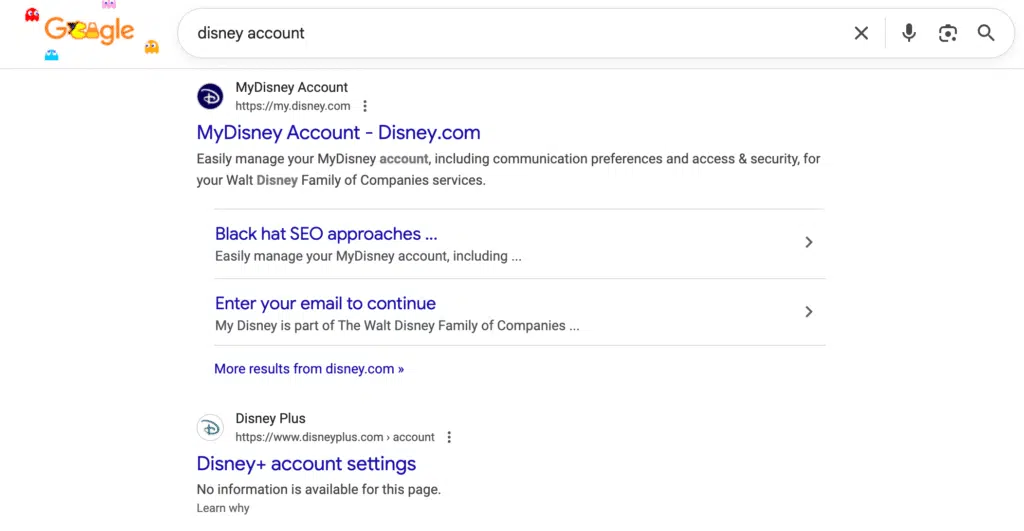
Barry Schwartz covered this:
Um – Disney doing some advanced SEO? 🙂 probably some SEOs having fun? via George Kamide pic.twitter.com/vCwoYP3gRo
— Barry Schwartz (@rustybrick) October 26, 2025
Why it matters:
This incident reveals how even major, authoritative domains can be affected by manipulative anchor-text, link hijacks, or indexing artefacts. It underscores the fact that search engines, especially in AI-driven or entity-centric displays, can still misattribute titles or links.
What to do:
- Audit structured data and sitelinks regularly for unexpected redirects.
- Use Search Console’s security alerts to detect anomalies early.
5. Google Clarifies Canonicals Are Case-Sensitive
What happened:
Google reiterated that URL case sensitivity still matters for canonicalisation. A mismatch between uppercase and lowercase versions can cause duplicate indexing issues or dilute ranking signals.
Comment
byu/poizster from discussion
inSEO
Why it matters:
Technical precision remains critical, especially as AI and indexing systems parse URLs at scale.
What to do:
- Standardise canonical tags and redirects to lowercase URLs.
- Re-crawl your site for inconsistent internal linking patterns.
6. Google Search Console Adds Query Groups
What happened:
Google Search Console Insights now includes a “Query Groups” card that clusters similar search queries into topic-based groups rather than listing each query individually. The groups are generated using AI and may evolve over time.
New in Search Console Insights: Query Groups. Makes it easier to track how things are changing (or not) for a group of similar queries from traditional search, AI Overviews, and AI Mode. #SEO #AEO developers.google.com/search/blog/…
— John Mueller (@johnmu.com) October 27, 2025 at 8:14 PM
[image or embed]
Why it matters:
This update shifts from keyword-by-keyword analysis toward topic-based visibility. It gives marketers a higher-level view of audience search intent and how their content is performing by theme.
What to do:
- Navigate to Insights → “Queries leading to your site” and review the grouped topics once the feature appears.
- Map query-groups to content clusters and identify under-performing groups for content refreshes.
Other Great Search Threads (Last Week of October 2025)
Here are the updated Other Great Search Threads (Last Week of October 2025) with links included:
- Gemini for Home Confirmed — Gagan Ghotra on X
→ Shared early screenshots showing Gemini’s integration with Google Home devices, signalling a push into ambient voice AI. (Link) - YouTube “Ask Studio AI” Feature Explained — Ginny Marvin on LinkedIn
→ A quick video overview of YouTube’s new AI analytics assistant, making data-driven insights conversational. (Link) - Microsoft Advertising Downtime Explained — Robert Brady on X
→ Detailed thread on how the brief October 28 outage impacted campaign pacing and automation. (Link) - Pomelli Breakdown — Nate J. Hake on X
→ Shared first impressions of Pomelli, Google Labs, and DeepMind’s new AI marketing tool, with screenshots and use-case examples. (Link) - Black-Hat SEO Still Alive — Andell Dam on X
→ Highlighted persistent cases of ranking manipulation and spam in high-value commercial SERPs. (Link) - Experiment Volume at Google — Malte Ubl (ex-Google) on X
→ Shared a data point: “My team at Google would run 3-5 experiments per week (so they were very well versed at it).” (Link)

Ridam Khare is an SEO strategist with 7+ years of experience specializing in AI-driven content creation. He helps businesses scale high-quality blogs that rank, engage, and convert.