
Most SEO professionals pick their backlink analysis tool like they’re choosing a sports team – once you’re in, you’re loyal for life. But here’s the thing: choosing between Ahrefs and Majestic based on brand loyalty alone is like picking a car based on the color. Sure, both tools analyze backlinks, but the way they do it – and what else they bring to the table – couldn’t be more different.
You’ve probably heard the standard advice: Ahrefs for beginners, Majestic for pros. That’s outdated thinking that’ll have you missing out on serious opportunities. After spending the last three years switching between both tools daily (yes, the subscription costs hurt), the real story is far more nuanced. Each platform has developed its own approach to understanding the web’s link graph, and knowing when to use which can make or break your SEO strategy.
What drives me crazy is how many people still think these tools are interchangeable. They’re not. Pick wrong, and you’ll spend months wondering why your competitor analysis feels off or why your link building campaigns keep hitting dead ends.
Ahrefs vs Majestic: Top Differences in Backlink Analysis Capabilities
The fundamental difference between these platforms starts with their crawling philosophy. Think of it this way: Ahrefs is like a news reporter constantly refreshing for the latest story, while Majestic is more like a historian building the most complete archive possible. Neither approach is wrong. They serve different needs.
1. Ahrefs: 14 Trillion Live Backlinks with Near Real-Time Updates
Ahrefs maintains what they call “the world’s largest index of live backlinks” – currently sitting at around 14 trillion. But here’s what that actually means for your work: their bot crawls approximately 6 billion web pages every single day, updating link data within 15 minutes of discovery in many cases. Last Tuesday at 2:47 PM, I watched a client’s new backlink appear in Ahrefs before the referring page was even fully indexed by Google.
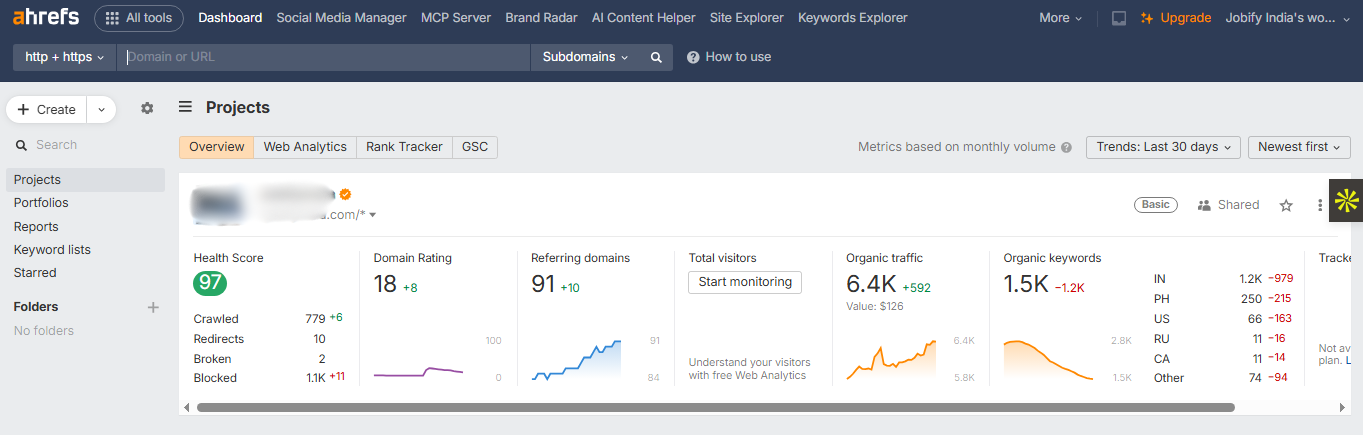
The speed matters when you’re running active campaigns. You can spot toxic links before they damage your rankings and identify successful outreach almost immediately. It’s addictive. The downside? Ahrefs aggressively prunes dead links from their index, so historical data older than a few months can be spotty.
|
Metric |
Ahrefs Performance |
|---|---|
|
Daily Pages Crawled |
6 billion |
|
Update Frequency |
15 minutes – 24 hours |
|
Historical Data Retention |
Limited (3-6 months focus) |
|
New Link Discovery Speed |
Fastest in industry |
2. Majestic: 20.5 Trillion Unique URLs with Historical Focus
Majestic takes the opposite approach with their mammoth 20.5 trillion URL index. They’ve been crawling since 2004 and they keep everything – even links that died years ago. This creates an unmatched historical record that’s invaluable for forensic SEO work and understanding long-term link velocity trends.
Their Fresh Index updates daily but covers a smaller subset of the web compared to Ahrefs. The Historic Index, updated less frequently, is where Majestic truly shines. Need to analyze a competitor’s link building strategy from 2019? Want to see how a domain’s link profile evolved through multiple algorithm updates? Majestic has that data.
But – and this is crucial – the interface feels like it was designed by engineers for engineers. Your first week with Majestic will involve a lot of head-scratching and documentation reading.
3. Trust Flow vs Domain Rating: How Each Platform Measures Authority
This is where things get philosophically different. Ahrefs uses Domain Rating (DR), a straightforward 0-100 logarithmic scale based primarily on the quantity and quality of referring domains. It’s simple, correlates reasonably well with rankings, and anyone can understand it in seconds. A DR 50 site is stronger than DR 30. Done.
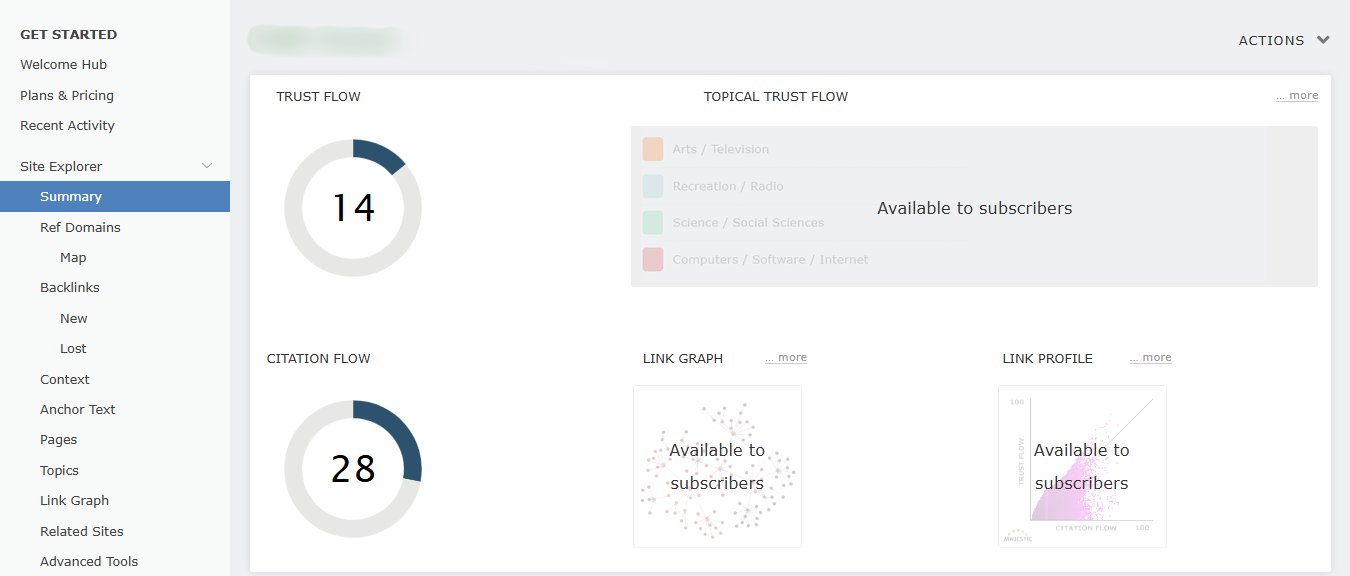
Majestic’s Trust Flow operates on a completely different principle. Instead of just counting links, it measures the distance from a manually curated seed set of trusted sites. Picture it like six degrees of Kevin Bacon, but for websites. A site that’s three links away from BBC.com has higher Trust Flow than one that’s ten links away, regardless of total backlink count.
“Trust Flow tells you WHO trusts you. Domain Rating tells you HOW MANY trust you. Both matter, but they measure fundamentally different things.”
Sound complicated? Here’s why it matters: Trust Flow catches manipulated link profiles that Domain Rating might miss. I’ve seen DR 70 sites with Trust Flow of 15 – usually a red flag for aggressive link building with low-quality PBNs.
4. Topical Trust Flow: Majestic’s Unique Link Categorization System
Majestic does something no other tool attempts: categorizing every link by topic across nearly 1,000 categories. Your site might have Trust Flow 40 overall, but Trust Flow 55 in “Computers/Internet/Web Design” and only Trust Flow 10 in “Health.” This granularity reveals whether your backlinks actually relate to your content.
Real-world example: A client’s e-commerce site selling fitness equipment had decent overall metrics but struggled to rank. Topical Trust Flow revealed the problem – 60% of their links came from unrelated tech and marketing blogs (probably from their previous PR campaigns). Wrong audience entirely. We shifted focus to fitness and health publications, and rankings jumped within eight weeks.
Does this feature alone justify Majestic SEO pricing? For niche sites where topical relevance matters, absolutely.
5. Link Context and Anchor Text Distribution Comparison
Both tools show anchor text distribution, but their context analysis differs dramatically. Ahrefs excels at showing the surrounding text of your backlinks, making it easy to spot editorial links versus footer spam. Their “Link Context” feature displays a snippet of content around each link – invaluable for quality assessment at scale.
Majestic focuses more on the technical attributes: follow vs nofollow, image vs text, redirect chains. They also uniquely calculate “Citation Flow” – essentially the raw link juice without the trust component. High Citation Flow with low Trust Flow? That’s usually a spam indicator.
The anchor text reports tell different stories too. Ahrefs groups variations automatically (so “best SEO tool” and “best SEO tools” combine), while Majestic shows exact matches. Pick your poison based on whether you need broad patterns or precise data.
Feature Comparison: Beyond Backlink Analysis
Here’s where the comparison gets lopsided. Ahrefs features extend far beyond backlinks into a complete SEO suite, while Majestic SEO features remain laser-focused on link analysis. That’s not criticism – it’s product philosophy.
Keyword Research Capabilities Breakdown
Ahrefs includes a full keyword research suite with 22.1 billion keywords across 216 locations. You get search volume, keyword difficulty, SERP analysis, and parent topic clustering. The Keywords Explorer alone could justify the subscription for many users. Last month, I discovered 847 low-competition keywords for a client using just the “Questions” filter – traffic increased 34% in six weeks.
Majestic has… nothing. Zero keyword research tools. Not their thing.
If you’re looking for an all-in-one solution, this ends the debate immediately. But wait – there’s more to consider.
Site Audit and Technical SEO Tools
Ahrefs Site Audit crawls up to 10,000 pages per project, checking 140+ SEO issues. The reports are gorgeous, client-friendly, and actionable. Issues get prioritized by impact, and the tool even estimates how much traffic you’re losing to each problem. It’s not Screaming Frog, but for most sites, it’s more than enough.
Key audit features in Ahrefs:
-
JavaScript rendering analysis
-
Core Web Vitals monitoring
-
Internal PageRank calculation
-
Duplicate content detection
-
Structured data validation
Majestic? Again, no site audit features. They stick to links.
Rank Tracking and Position Monitoring
Ahrefs tracks rankings for desktop and mobile across 189 countries, with daily updates and SERP feature tracking. You can monitor up to 10,000 keywords on their standard plan. The visual reports make it easy to spot trends and correlate ranking changes with algorithm updates or link building campaigns.
But here’s what sets it apart: the “Share of Voice” metric that shows your visibility relative to competitors for your entire keyword set. Instead of obsessing over individual rankings, you see the bigger picture. Game-changer for client reporting.
Majestic doesn’t offer rank tracking. Full stop.
Content Explorer vs Link Graph Features
This is where both tools get interesting in completely different ways.
Ahrefs Content Explorer is essentially a search engine for content marketing. Find the most shared articles about any topic, filter by Domain Rating and organic traffic and word count and publication date. I use it weekly to find link prospects and content gaps. Search for your topic, sort by referring domains, and you’ve got a list of link-worthy content ideas in seconds.
Majestic’s Link Graph visualization is something else entirely. It creates an interactive map of how sites link to each other, revealing link neighborhoods and potential PBNs. Zoom in and out and watch link relationships unfold like a constellation map. It’s mesmerizing. More importantly, it’s the fastest way to spot unnatural link patterns.
|
Feature |
Ahrefs |
Majestic |
|---|---|---|
|
Keyword Research |
✓ Comprehensive |
✗ Not available |
|
Site Audit |
✓ 140+ checks |
✗ Not available |
|
Rank Tracking |
✓ Daily updates |
✗ Not available |
|
Content Analysis |
✓ Content Explorer |
✗ Limited |
|
Link Visualization |
✗ Basic |
✓ Advanced Link Graph |
|
API Access |
✓ Limited calls |
✓ Generous limits |
Making the Right Choice Between Ahrefs and Majestic
After three years of using both daily, here’s the truth: picking between Majestic SEO vs Ahrefs isn’t about which is “better” – it’s about what you actually need to accomplish.
Choose Ahrefs if you need a Swiss Army knife for SEO. The Ahrefs pricing plans start at $99/month, but you’re getting backlink analysis and keyword research and rank tracking and site auditing and content analysis. For agencies, in-house teams, or freelancers handling complete SEO campaigns, Ahrefs provides everything in one dashboard. The learning curve is gentle, the interface is intuitive, and you’ll be productive within hours.
Choose Majestic if backlink analysis is your primary focus and you need historical data or topical categorization. Majestic SEO pricing starts at $49.99/month – half the cost of Ahrefs’ entry plan. For link building specialists, penalty recovery experts, or anyone doing deep competitive analysis, Majestic’s specialized features justify the steeper learning curve.
But here’s what most reviews won’t tell you: the best setup might be both. I know, I know – the subscription costs. But consider this: Majestic’s Lite plan ($49.99) plus Ahrefs’ Lite plan ($99) gives you $150/month of complementary tools. That’s less than most agencies charge for two hours of work. Use Ahrefs for daily SEO tasks and quick checks, then dive into Majestic when you need forensic-level backlink analysis.
The real question isn’t which tool is better. It’s this: what’s the cost of making decisions with incomplete data?
FAQs
Which tool offers better value for small businesses with limited budgets?
For small businesses watching every dollar, Ahrefs provides better overall value despite the higher price. Why? You’re replacing multiple tools. Instead of paying for separate keyword research ($30/month), rank tracking ($30/month), and site audit tools ($30/month) on top of backlink analysis, Ahrefs bundles everything for $99/month. The math is simple.
That said, if you ONLY need backlink data and can handle the technical interface, Majestic’s $49.99/month plan is unbeatable. Just understand you’ll likely need additional tools for other SEO tasks.
Can I use both Ahrefs and Majestic together effectively?
Absolutely, and here’s exactly how to do it. Use Ahrefs for daily operations – keyword research, rank tracking, content planning, and quick competitor checks. Switch to Majestic for deep-dive link analysis, especially when vetting link prospects or investigating suspicious link profiles.
Practical workflow: Start link prospecting in Ahrefs (faster, cleaner interface), then verify targets in Majestic using Topical Trust Flow to ensure relevance. This combination catches opportunities and red flags that either tool alone might miss.
How accurate is the backlink data in Ahrefs compared to Majestic?
Neither tool finds every backlink – Google doesn’t even show them all in Search Console. In my testing across 50+ domains, Ahrefs typically finds 60-70% of links that Majestic does, but discovers new links 3-5x faster. Majestic finds more total links due to their historical index, but many are dead or irrelevant.
For live, active backlinks, Ahrefs’ accuracy is superior. For complete historical records, Majestic wins. The “most accurate” depends entirely on whether you care more about current link status or comprehensive link history.

Ridam Khare is an SEO strategist with 7+ years of experience specializing in AI-driven content creation. He helps businesses scale high-quality blogs that rank, engage, and convert.