

Everyone wants quality backlinks. Almost nobody wants to do what it actually takes to earn them.
I’ve spent the last 90 days heads-down on link building for rayo.work. Here’s where we landed:
- Authority Score: 13
- Referring Domains: 285
- Backlinks: 14.8K
- Monthly organic traffic: 16 visits
Not a flex. An honest snapshot. And more than enough to teach you what’s actually working in 2026 — and what isn’t.
Because here’s the truth: most backlink advice on the internet is recycled from 2019 wearing a 2026 costume. I threw out about 70% of what I read. What’s left is this post.
It’s not a case study. It’s a playbook — the exact tactics, templates, and tools I’d use if I were starting from scratch tomorrow to build high quality backlinks for a SaaS blog. No paid placements. No PBNs. No $5K/month agency. Just what moves the needle right now.
What’s inside:
- What a quality backlink actually means in 2026 (the definition has shifted)
- 6 tactics that work, mapped to a 90-day plan you can copy
- Every outreach email template worth sending
- How to spot and avoid toxic links
- A free Google Sheets tracker to run the whole thing
If you’re a founder, in-house marketer, or solo SEO building backlinks without burning cash — this one’s for you.
Let’s get into it.
What Are Quality Backlinks? (And Why 2026 Changed Everything)
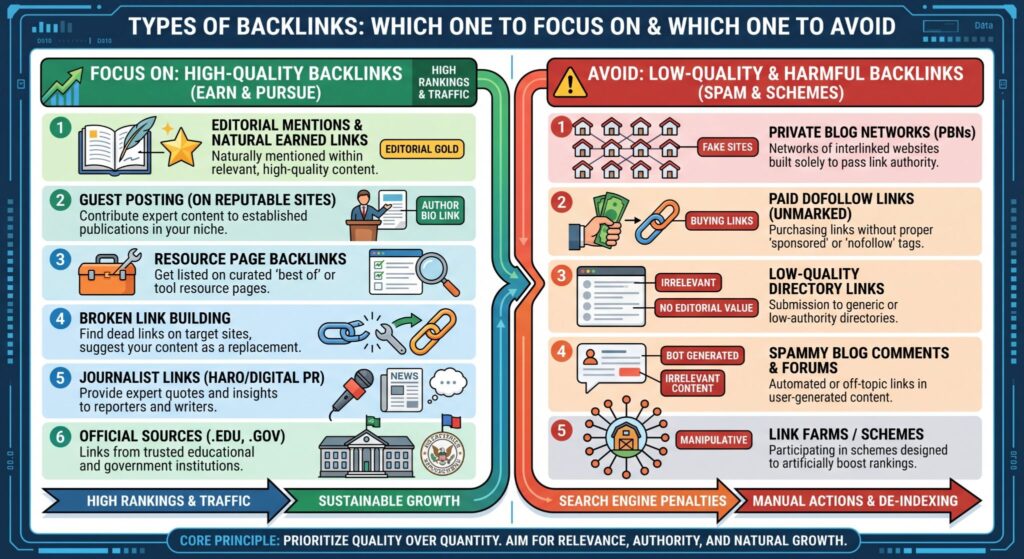
If you learned link building before 2023, most of what you know is outdated. The rules changed twice — first when search moved to entity-based ranking, then when AI answer engines started deciding who to cite.
The 2026 definition
A quality backlink is a contextually relevant, editorially earned link from a site with real topical authority — placed in content your audience actually reads.
The shift: search engines care far less about how “strong” a site looks in isolation, and far more about where a link lives and why it’s there. A link from a small, tightly focused niche site now routinely beats one from a massive general publication.
5 signals of a high-quality backlink
- Relevance — does the site cover your niche?
- Contextual placement — in-body, not footer or sidebar
- Editorial context — placed by a human who meant it
- Entity strength — real brand, authors, topical identity
- Engagement — does the page actually get traffic?
Fail three, skip the link. DR doesn’t matter.
The GEO shift
Backlinks now also decide whether ChatGPT, Perplexity, and Google AI Overviews cite you. AI engines pull from a narrower, trust-weighted pool — weighted hardest on entity strength and topical relevance. High quality backlinks don’t just rank you anymore. They teach AI models you’re the authority.
DA/DR alone? Dead metric. Topical fit won.
The Baseline — Where Rayo Stands Today
Before I hand you tactics, you deserve to see the site they’re being run on. No DR 80 flex site. No agency-polished case study. Just rayo.work, a real SaaS blog doing the work.
Here’s the honest Semrush snapshot:
- Authority Score: 13
- Referring Domains: 285
- Backlinks: 14.8K
- Monthly organic traffic: 16 visits
- 85% of referring domains sit in the AS 0–10 range
- Top referring countries: Singapore, US, Moldova
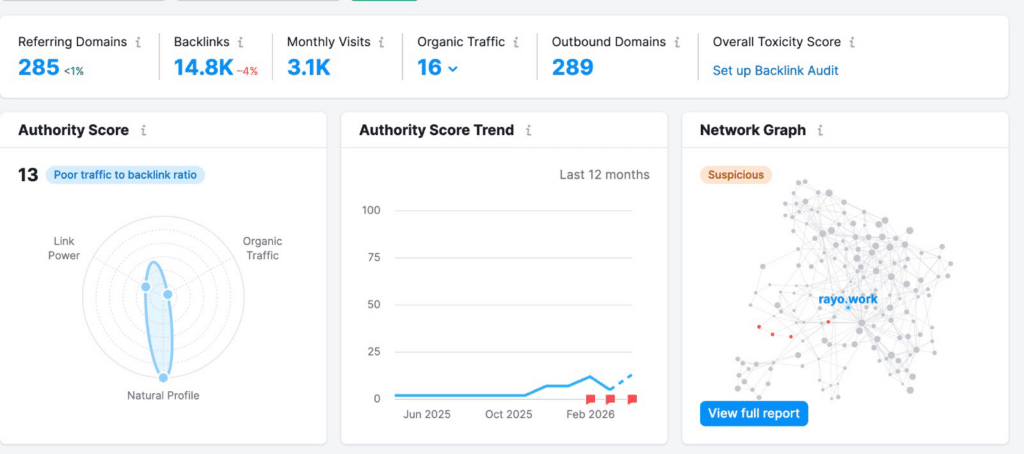
Not pretty. Useful.
Most of those 14.8K backlinks are low-quality directory and scraper links that accumulated before we started paying attention — the kind of profile a lot of SaaS sites quietly carry. The job for the next stretch isn’t “get more links.” It’s to build quality backlinks that shift the composition of the profile: more topical relevance, more editorial context, fewer AS 0–10 stragglers.
The rules I’m running
- No paid links. Not guest post fees, not PBNs, not link vendors.
- No private blog networks. Ever.
- No agency. Every outreach email, every pitch, every follow-up — in-house.
- Free tools only. Semrush free tier, Google Search Console, Hunter.io free plan, Google Sheets.
The rules are the point. Anyone with a budget can buy links. Almost nobody can build a real link profile without one. That’s the case study worth writing.
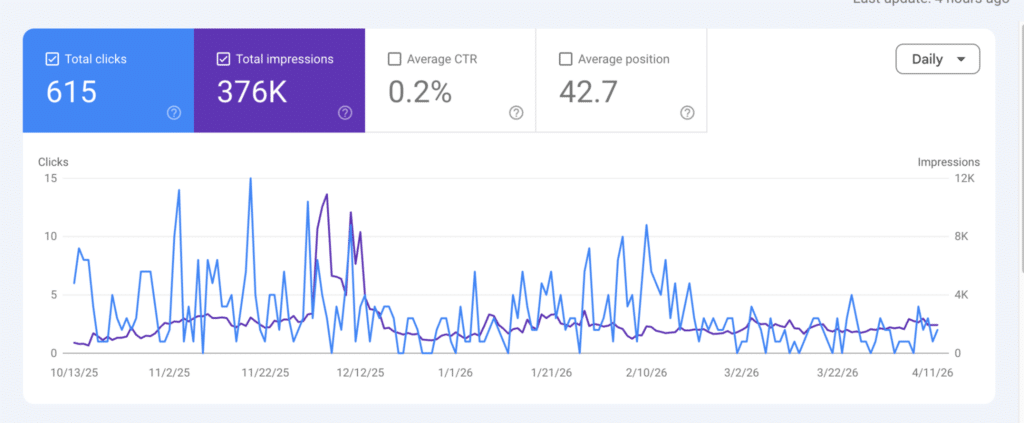
Starting honest beats starting polished. Let’s get into the tactics.
#1 Month 1 — Quick-Win Tactics That Built Momentum
Month 1 is about claiming links that are already owed to you or already waiting. Three tactics. All free. All repeatable.
Tactic 1 — Unlinked Brand Mention Reclamation
People mention your brand without linking to it all the time. Claim those first — the endorsement already exists.
Step 1 — Find every mention (free).
Run these Google operators weekly:
“your brand” -site:yourdomain.com
“your brand” -site:yourdomain.com -site:linkedin.com -site:twitter.com -site:facebook.com
“yourbrand.com” -site:yourdomain.com
“founder name” + “your brand”
Set up continuous monitoring (pick any two, all free):
- Google Alerts → alerts for brand name, product name, founder name, variations (misspellings too)
- Talkwalker Alerts → catches what Google Alerts misses
- Semrush free tier → Brand Monitoring tool, 1 project free
- F5Bot → free Reddit, Hacker News, and forum mention alerts (underrated)
- Mention.com free trial for deeper social coverage
Step 2 — Find the author’s email.
Chrome extensions that give free monthly credits:
- Hunter.io (25 free searches/mo) — paste the domain, get verified emails
- Apollo.io (free plan, 50 credits/mo) — better for smaller sites Hunter misses
- Snov.io (50 free credits/mo) — backup for the above
- FindThatLead or Skrapp — rotate when you burn credits
Pro move: stack all three free plans on different emails = ~125 free lookups/month, zero cost.
Step 3 — The email.
Subject: Quick thanks — small favor
Hey [First name],
Saw you mentioned [Brand] in your piece on [topic] — appreciate the shout.
Noticed the mention isn’t linked. Any chance you could link it to [URL]? Takes 10 seconds and helps readers who want to check us out.
Either way, solid piece — especially the part about [specific detail proving you read it].
—
[Your name]
Two rules that make this work: (1) reference a specific detail from the post so they know you read it, and (2) give them one clear ask, not three.
Reply rate: 60–80% when the site is still active. Highest-converting tactic in the entire playbook.
Time: ~2 hours/week.
Tactic 2 — HARO Replacements (Featured, Qwoted, SourceBottle)
HARO shut down in late 2024. In 2026, these are the platforms journalists actually use:
- Featured.com — free tier, daily digest, highest volume
- Qwoted.com — free plan, better for B2B/SaaS queries
- SourceBottle — free, stronger in AU/UK
- Help a B2B Writer — free, niche SaaS goldmine
- Terkel.io — free, pitch once, gets syndicated across 200+ sites
- JournoRequests on X — search #journorequest + your niche daily
The 15-min daily routine:
- 9:00 AM — open email digests from Featured + Qwoted + Help a B2B Writer
- Filter for queries in your niche (search “SaaS,” “AI,” “startup,” “marketing”)
- Pick 1–2 where you have genuine, specific expertise
- Pitch in under 10 minutes
- Log it in your Sheets tracker (query, date pitched, outlet)
- Close tab
The pitch template that actually gets picked:
Subject: Re: [exact query subject line]
Hi [Journalist],
I run SEO at Rayo, a SaaS that’s grown from 0 to 285 referring domains in 11 months, so I can give a data-backed answer to this.
Answer:
Most people overcomplicate link building — the fastest wins come from targeting pages already ranking #5–#15 and pushing them up with internal links. We increased organic traffic by 38% in 60 days just by redistributing internal links, without building a single new backlink. The leverage isn’t in more links — it’s in better link placement.
Example: We took one page from position #9 to #3 by adding 12 contextual internal links from high-authority pages.
Happy to expand.
Bio:
[Your Name], [Your Role] at [Your Company]
[Your URL]
Headshot:
View here
Best,
[Your Name]
Why most HARO pitches fail: no specificity. Journalists get 40+ pitches per query — they pick the one with a real number, a real example, and a quotable sentence. If your pitch could be sent to any query in the niche, it gets deleted.
Realistic pickup rate: 15–25% on genuine expertise matches. Pitch 20/month, expect 3–5 live mentions.
Tactic 3 — Resource Page Link Building (The Right Way)
Resource pages exist to link out. You just have to find active ones and pitch cleanly.
Step 1 — Google operators to find them:
- intitle:”resources” + “[your niche]”
- intitle:”resources” + “tools” + “[niche]”
- inurl:resources + “[niche]”
- inurl:links + “[niche]”
- “useful resources” + “[niche]”
- “recommended tools” + “[niche]”
- “best [niche] tools” inurl:resources
Step 2 — Filter the winners (this is where most people quit early).
Install these Chrome extensions:
- MozBar (free) — shows DA of each SERP result inline
- Ahrefs SEO Toolbar (free with any Ahrefs account) — DR + traffic overlay
- SEO Minion (free) — bulk-check SERP positions and on-page elements
- Detailed SEO Extension (free) — audits the page you’re on in 1 click
- LinkMiner (free trial, Mangools) — catches broken links on the resource page itself
- Check My Links (free) — scans any page for broken outbound links (pair with broken link building in Month 2)
Qualify each page:
- Updated in the last 12 months? ✓
- Has contact form or visible email? ✓
- Links to sites comparable to yours (not just Fortune 500)? ✓
- Not stuffed with 200+ links? ✓
Kill the rest. 50 qualified prospects beats 500 random ones.
Step 3 — The pitch.
Subject: Resource suggestion for [exact page title]
Hey [First name],
Your [page topic] resource list is one of the better ones I’ve used — the [specific entry] recommendation especially helped us with [specific use case].
Running through it, I thought [Your tool/resource] might fit too:
→ [URL]
→ What it does: [10 words, no marketing fluff]
→ Why it fits this list: [one specific reason tied to the page’s theme]
If it’s useful to your readers, great. If not, zero worries — page is solid regardless.
—
[Your name]
[Role], [Company]
Realistic conversion: 5–10%. Pitch 50 qualified prospects, land 3–5 editorial links on pages built to link out. These links age well.
Outreach stack that saves hours (all have free tiers)
| Tool | What it does | Free tier |
| Hunter.io | Email finder + verifier | 25/mo |
| Apollo.io | Email finder + contact DB | 50 credits/mo |
| Snov.io | Email finder + drip campaigns | 50 credits/mo |
| Mailtrack / Streak | Open tracking in Gmail | Free forever |
| GMass | Mail merge from Google Sheets | 50 emails/day free |
| Boomerang | Schedule sends + follow-up reminders | Free tier |
| Google Sheets | Your outreach CRM | Free |
The workflow: prospects → Sheet → Hunter/Apollo for emails → GMass mail merge → Mailtrack for opens → follow up at Day 4 and Day 9 → log replies in the Sheet. That’s it. No paid Pitchbox subscription needed in Month 1.
Month 1 Results box
| Metric | Realistic Month 1 outcome |
| Links earned | 10–15 |
| Time invested | 20–25 hours |
| Best ROI | Unlinked mention reclamation |
| Worst ROI | Stale resource pages (filter harder) |
| AS movement | Usually none yet — foundation month |
Month 1 doesn’t move the score. It builds the outreach muscle and the prospect database you’ll compound in Month 2.
# 2 Month 2 — Scaling Outreach for Quality Backlinks
Month 1 built the muscle. Month 2 is where outreach compounds. Three tactics, higher effort, higher ceiling — and the point where quality backlinks start showing up in the tracker faster than you can log them.
Tactic 4 — Broken Link Building (1:1 Replacement Strategy)
The pitch is almost unfair: “Hey, you have a broken link. Here’s a working replacement.” You’re solving the site owner’s problem before they knew they had one.
Step 1 — Find broken links on pages that matter.
Install these free Chrome extensions:
- Check My Links (free) — scans any page, highlights broken outbound links in red in ~2 seconds
- LinkMiner by Mangools (free plan) — shows broken links + DR of the page hosting them
- Domain Hunter Plus (free) — finds expired/broken links across an entire site
- Broken Link Checker (free Chrome extension) — bulk-scan lists of URLs
Step 2 — Google operators to find target pages:
- intitle:”resources” + “[your niche]”
- intitle:”best tools” + “[your niche]”
- inurl:links + “[your niche]”
- “further reading” + “[your niche]”
- site:edu + “[your niche]” + “resources”
- site:org + “[your niche]” + “resources”
- .edu and .org resource pages are gold — they rarely audit their outbound links and they carry real entity weight.
Step 3 — The 1:1 match rule (this is the whole game).
Cold broken link building success rates climb to around 20% when your replacement is a perfect 1:1 match for the dead resource. Generic “here’s my blog, link to me instead” pitches convert at 1–2%.
Before pitching, check the dead URL on the Wayback Machine (web.archive.org) to see what the original content was. Then one of three things is true:
- You already have a matching piece → pitch it directly
- You have something close → update it to match the original’s angle, then pitch
- You have nothing → skip the prospect (don’t force a bad match)
This filtering is why most people fail at BLB. They pitch whatever they have. You only pitch what actually replaces the dead link.
Step 4 — The email:
Subject: Broken link on your [page topic] page
Hey [First name],
Was reading your piece on [page topic] — the section on [specific detail] genuinely helped me think about [X].
Quick FYI: the link to [anchor text / dead domain] under [section name] is dead — looks like the original site went down sometime in [year] (via Wayback).
If useful, we published something that covers the same ground: [URL]
– [1-line match to what the dead resource was about]
– [1-line credibility signal: data, citations, etc.]
Zero pressure — wanted to flag the broken link either way.
—
[Your name]
Two things this email does right: it leads with a favor (broken link notice), and the replacement is optional, not demanded.
Realistic numbers: pitch 100 prospects where you have a true 1:1 match → 15–20 links. At scale, this is the highest-quality tactic in the playbook.
Tactic 5 — Podcast Guesting (Show Note + Bio Links)
Every niche podcast episode ships with show notes. Show notes almost always include guest links — dofollow, in-content, on a page that gets real traffic. One 45-minute recording = one permanent link + a referral audience.
Step 1 — Find podcasts that actually book guests.
Free databases:
- Listen Notes — free search, filter by topic + language
- Podchaser — free, shows episode guest history
- Rephonic free trial — audience size + related podcasts
- MatchMaker.fm — free platform where podcasters actively post guest calls
- PodcastGuests.com — free listings of shows seeking guests
- Apple Podcasts → search your niche → sort by recency (only pitch shows that published in the last 30 days)
Filter criteria — only pitch shows that:
- Published an episode in the last 30 days (dead shows waste your time)
- Feature guests regularly (not solo-host shows)
- Publish written show notes with clickable guest links (check 2–3 recent episodes)
- Have a real audience — Rephonic or Listen Notes shows estimated listeners
Build a list of 30 qualified shows. Quality over quantity.
Step 2 — The pitch angle that gets booked.
Generic pitches get ignored. Specific, episode-referenced pitches get booked.
Subject: Guest idea for [Podcast name] — [specific angle]
Hey [Host name],
Binged your episode with [past guest] on [topic] last week — the point about [specific quote/idea] was the cleanest framing I’ve heard of that problem.
Wanted to pitch a guest angle that builds on it:
“[Episode title you’re proposing]”
What we’d cover:
– [Talking point 1 — specific, counterintuitive]
– [Talking point 2 — data or framework-based]
– [Talking point 3 — tactical takeaway]
About me: [One line — role, relevant credibility, why this topic specifically].
Past mentions/writing:
[Link 1],
[Link 2]
Happy to send a longer outline if the angle lands.
—
[Your name]
Rules: reference a specific past episode (proves you’re not spamming), pitch an episode title (makes it easy to say yes), and include 3 concrete talking points (removes the host’s prep burden).
Realistic numbers: pitch 30 shows → 5–8 bookings → 5–8 show-note links on pages with existing audiences. Bonus: podcast listeners convert 3–5× better than cold SEO traffic.
Tactic 6 — Link Insertions via Value-First Outreach
Link insertions = getting your link added to existing, already-ranking content. Faster than new guest posts, and the host page’s SEO equity transfers to the link immediately.
Step 1 — Find the right pages.
You want pages that:
- Rank on page 1 for keywords you care about
- Were last updated 12+ months ago (dated = updatable)
- Have a clear author or editor contact
- Cover a topic where your content genuinely adds something missing
How to find them:
- “[target keyword]” + inurl:blog
- “[target keyword]” intitle:2023 OR intitle:2024
- “[target keyword]” + “updated”
Then sort results by “last year” in Google’s Tools filter.
Step 2 — The “genuine improvement” angle.
Don’t pitch “please add my link.” Pitch a specific content upgrade:
- A newer data point (their stat is from 2022 → you have 2026 data)
- A missing sub-topic (their guide to X has no section on Y)
- A case study or example they lack
- A visual asset (chart, calculator, template) they’d benefit from embedding
Step 3 — The email:
Subject: Small suggestion for your [article title] post
Hey [First name],
Came across your piece on [topic] while researching [X].
Really useful — especially [specific section].
Noticed one section could be worth refreshing:
[Section name]:
Currently cites [outdated stat / missing angle]. We pulled newer data in our post showing [specific insight in one line].
If it’s useful to your readers, a link or embed of the [chart/section] slots naturally into that paragraph.
If not, no worries — piece is already strong.
—
[Your name]
The “skyscraper” variant: if your piece is a clear upgrade of theirs (fresher data, deeper coverage, better examples), pitch it as a direct content upgrade — not a link swap. Link swaps look transactional. Content upgrades look editorial.
Realistic conversion: 8–12% when your improvement is genuine. Pitch 50 → 4–6 editorial insertions on already-ranking pages.
Scaling stack for Month 2
| Tool | Job | Free tier |
| Hunter + Apollo + Snov (stacked) | Email finding at volume | ~125 credits/mo combined |
| GMass | Gmail mail merge from Sheets | 50 emails/day free |
| Mailtrack / Streak | Open tracking | Free forever |
| Boomerang | Schedule + auto follow-up | Free tier |
| Wayback Machine | Verify dead resource content | Free |
| Check My Links / LinkMiner | Broken link discovery | Free |
| Listen Notes / MatchMaker.fm | Podcast prospecting | Free |
| Google Sheets | CRM + tracker | Free |
Month 2 Results box
| Metric | Realistic outcome |
| Links earned | 15–25 |
| Time invested | 35–45 hours |
| Best ROI | Broken link building (with 1:1 match rule) |
| Worst ROI | Generic podcast pitches |
| AS movement | First small movement possible — 1–3 points |
| Bonus | Podcast referral traffic starts showing up in GA4 |
Month 2 is where the tracker starts filling faster than you can log. The work compounds because Month 1’s prospects start replying late, Month 2’s outreach kicks in fresh, and the same Google Sheet turns into an asset.
Month 3 is where it gets interesting — one asset earns more links than all six tactics combined.
Month 3 — The Linkable Asset That Earns Links on Autopilot
Months 1 and 2 were outbound — you chased every link. Month 3 flips the model: you build one asset so useful that links come to you.
This is the tactic nobody wants to do because it takes real work. It’s also the only one that keeps earning links after you stop pitching.
Why one good asset beats 100 guest posts
The scale ceiling matters. Semrush’s AI search study attracted more than 4,000 backlinks from over 900 unique domains — from a single piece of original research. You won’t replicate 4K backlinks. But the mechanism is copyable at any scale: original data + specific audience + a statistic worth citing.
Even at 1% of Semrush’s scale, that’s 40 links from 9 domains — from one asset. Most sites never earn that from a year of outreach.
The 3 asset types that actually attract links in 2026
- Original statistics roundup — aggregate + analyze public data into one canonical resource
- Proprietary data study — run a survey, scrape a dataset, or analyze your own product data
- Free interactive tool — calculator, template generator, comparison engine
Pick one. Don’t spread thin across all three. For a solo operator, the statistics roundup has the best effort-to-link ratio — you’re curating existing public data, not commissioning new research.
How to build a statistics roundup that gets cited
Step 1 — Pick a topic journalists actually cover.
Your topic needs to be (a) in your niche, (b) something journalists write about repeatedly, and (c) under-served by current stat roundups.
Test it: Google “[topic] statistics 2026”. If the top 10 results are thin, outdated, or missing recent data — you have a gap.
Step 2 — Collect 50–100 cite-worthy stats.
Pull from:
- Public industry reports (McKinsey, Gartner, Deloitte, Statista free)
- Academic papers on Google Scholar
- Government data (BLS, Census, Eurostat)
- Recent surveys from SaaS companies in your space (they publish to get cited too — borrow their data, cite them back)
- Original analysis of publicly available data (GitHub, Kaggle, company transparency reports)
Rule: every stat gets a primary source link. No stat survives if you can’t trace it to the original study.
Step 3 — Structure it to get cited.
Journalists and bloggers cite stats pages for three reasons — optimize the page for all three:
- Jump-linked table of contents (so they can find the stat category fast)
- Bolded, quotable stat at the top of each section (easy to copy-paste into an article)
- Source link next to every stat (they need the original citation)
- A “latest data as of [month/year]” stamp (freshness is the cite-or-skip signal)
Step 4 — Add one original insight.
This is the ONE thing that makes journalists cite your page instead of the primary source: your own analysis on top of the aggregated data. A single original chart, calculated trend, or comparison they can’t get elsewhere. That’s the hook.
Without it, you’re a middleman — they’ll skip you and cite the source. With it, you become the source.
Promotion: how to launch without email blasts
Email outreach for a stats asset gets 1% reply rates. Do this instead:
- Journalist-first outreach (not mass blast). Identify 20 journalists who’ve written about your topic in the last 6 months (use site:[publication] + “[topic]” operators). Send individualized, short emails with the 2 most surprising stats — not the whole roundup.
- Publish on Reddit + Hacker News the same day. In niche subreddits (r/SaaS, r/marketing, etc.) — share as “I compiled X stats on Y, here’s what surprised me.” Lead with the insight, link second.
- Slice into 10+ social posts. Each stat = one LinkedIn/X post over 3 weeks. Each post points back to the roundup. Drives consistent referral traffic and signals engagement to AI engines.
- Syndicate to Terkel, Featured.com, Qwoted → pitch “I have fresh data on [topic]” when relevant queries drop. Journalists looking for sources find you via the platform.
- Add a “cite this” box on the page with pre-formatted citation text. Remove every gram of friction between “journalist likes stat” and “journalist publishes link.”
The compounding happens because each early citation feeds the next — once 5 journalists have linked you, the 6th finds you by searching.
Month 3 Results box (realistic benchmarks)
| Metric | Small-scale asset benchmark |
| Build time | 40–60 hours |
| Promotion time | 10–15 hours |
| Links in first 30 days | 5–15 |
| Links in next 90 days (passive) | +10–30 compounding |
| Cost | $0 if you do the work yourself |
| Best signal of success | First unsolicited link from a journalist you didn’t pitch |
The goal of Month 3 isn’t links in week 12. It’s building an asset that earns links in month 6, month 12, and month 24 — with no additional outreach.
One well-built data page will out-earn every cold email you ever send.
How to Use a Backlink Quality Checker (Avoid Toxic Links)
Not every link is worth having. Some actively hurt you. Before and after any outreach campaign, you need a backlink quality checker in the workflow — to vet prospects before pitching and audit your own profile for toxic inbound links after.
Why this matters more in 2026
Google’s spam systems got far better at detecting manipulative link patterns. Sites with a high ratio of low-quality, irrelevant, or paid-pattern backlinks don’t just fail to rank — they get suppressed. The job isn’t collecting links. It’s protecting your profile.
The free tools that actually work
- Ahrefs Webmaster Tools — free for verified domain owners. Full backlink profile, DR, and referring domain breakdown.
- Semrush Backlink Audit — free tier gives toxicity scores per link. Best free toxicity detector.
- Moz Link Explorer — 10 free queries/month. Spam Score is the metric to watch.
- Ubersuggest — 3 free queries/day. Good for quick spot-checks.
- Google Search Console — free, authoritative. Your Links report shows what Google actually sees.
Stack all five on the same Google account = ~50 free audits/month.
How to run a single backlink through a checker
- Copy the referring URL from your Ahrefs/Semrush profile
- Paste it into a backlink quality checker (start with Semrush for toxicity)
- Cross-check against Moz’s Spam Score
- Manually visit the page — if it looks spammy to you, it is
3 red flags that mean the link is toxic
- Semrush Toxicity Score 60+ — automatic disavow candidate
- Moz Spam Score 7+ — high risk, investigate manually
- “Traffic” shows near-zero but “outbound links” in the thousands — classic link farm signature
What to do with toxic links (disavow process)
- Export toxic links to a .txt file, one URL per line, prefix with domain: to disavow the whole referring domain
- Go to Google’s Disavow Tool
- Select your property, upload the file
- Google processes in 2–4 weeks
Don’t disavow recklessly — every link you disavow is one Google will never count again. Rule of thumb: only disavow if the Toxicity Score is 60+ and the link is clearly non-editorial.
My 5-point checklist before accepting any new link
- Relevance — does the linking site cover my niche?
- Traffic — does Semrush/Ahrefs show real organic traffic?
- Outbound link ratio — fewer than 100 external links on the page?
- Spam/Toxicity Score — below 30 on both Semrush and Moz?
- Editorial context — placed in body content, by a real human?
The Full Results — 90-Day Breakdown (write at Day 90)
The Full Results — 90-Day Breakdown
Ninety days in. Here’s the honest picture.
Week-by-week RD growth
| Week | Referring Domains | New RDs | Cumulative Links |
|---|---|---|---|
| Start | [X] | — | [X] |
| 1 | [X] | [X] | [X] |
| 2 | [X] | [X] | [X] |
| … | … | … | … |
| 12 | [X] | [X] | [X] |
Links by tactic
| Tactic | Time Invested | Links Earned | Avg DR |
|---|---|---|---|
| Unlinked mention reclamation | [X] hrs | [X] | [X] |
| HARO / Featured pitches | [X] hrs | [X] | [X] |
| Resource page pitches | [X] hrs | [X] | [X] |
| Broken link building | [X] hrs | [X] | [X] |
| Podcast guesting | [X] hrs | [X] | [X] |
| Link insertions | [X] hrs | [X] | [X] |
| Linkable asset | [X] hrs | [X] | [X] |
The one metric that surprised me
[Write one honest paragraph on what moved more or less than expected.]
What to capture over the 90 days so this section writes itself at Day 90:
- Weekly Semrush RD count (screenshot every Monday)
- Every link logged in the Sheets tracker (URL, tactic, date earned, AS/DR)
- GSC performance baseline screenshot on Day 0 + Day 90
- Authority Score on Day 0, Day 30, Day 60, Day 90
The Free Toolkit (Every Tool Used, Zero Spend)
Everything in this playbook runs on free tools. Here’s the stack, organized by job:
Backlink & SEO analysis
- Semrush (free tier) — backlink profile, toxicity audit, keyword tracking (10 queries/day)
- Ahrefs Webmaster Tools — free for verified owners, full backlink data
- Google Search Console — authoritative rankings + link data
- Moz Link Explorer — 10 free queries/month
Prospect discovery
- Google Alerts + Talkwalker Alerts — brand mention monitoring
- F5Bot — free Reddit/HN/forum alerts
- Listen Notes + MatchMaker.fm — podcast prospecting
Outreach
- Hunter.io — 25 free email searches/month
- Apollo.io — 50 free credits/month
- Snov.io — 50 free credits/month
- GMass — free Gmail mail merge (50/day)
- Mailtrack or Streak — free open tracking
Journalism / HARO replacements
- Featured.com — free tier
- Qwoted — free plan
- Help a B2B Writer — free
- Terkel.io — free
Your 30-Day Action Plan to Replicate This
You don’t need to run the full 90 days to see movement. Here’s the compressed 30-day version.
Week 1 — Foundation
- Verify your domain in Semrush + Ahrefs Webmaster Tools + Google Search Console
- Run baseline audit — screenshot AS, RDs, backlinks, traffic
- Set up Google Alerts + F5Bot for your brand name
- Duplicate the free Outreach Tracker into your own Sheets
- Install Check My Links + Hunter.io Chrome extensions
Week 2 — Quick wins (unlinked mentions)
- Run 5 Google operators for unlinked mentions
- Build a prospect list of 20 unlinked mentions in Sheets
- Find emails via Hunter/Apollo
- Send 20 reclamation emails (use the template from H2 #4)
- Log replies daily
Week 3 — HARO + Resource pages
- Subscribe to Featured.com, Qwoted, Help a B2B Writer
- Pitch 2 HARO-style queries per day (10 total)
- Find 30 resource pages via Google operators
- Qualify them against the 5-point checklist
- Pitch top 15
Week 4 — Broken link building + review
- Scan 20 niche resource pages with Check My Links
- Find 10 broken links with 1:1 content matches on your site
- Send 10 broken-link outreach emails
- Review Week 1–4 results, update the tracker
- Screenshot your Day 30 AS and RD count for comparison
Realistic Day 30 outcome: 5–12 new links, outreach muscle built, prospect database of 100+ contacts to compound against in Days 31–90.
FAQ
Expect 60–90 days to see meaningful movement in referring domains, and 4–6 months before Authority Score shifts. Tactics like unlinked mention reclamation can yield links in days. Linkable assets compound over 6–12 months. Consistency outperforms intensity — 30 minutes daily beats 8 hours monthly.
There’s no fixed number — it depends on your niche’s competitiveness and your competitors’ profiles. For low-competition SaaS keywords, 20–50 topically relevant links often suffice. Competitive keywords may require 200+. Focus on referring domain diversity and topical relevance, not raw link count.
Five signals: topical relevance to your niche, in-content editorial placement, real editorial intent behind the link, strong entity authority of the linking site, and genuine engagement on the page. Domain Rating alone is no longer a reliable quality signal — relevance and entity strength now matter more.
Yes. Every tactic in this guide runs on free tools: Semrush free tier, Google Search Console, Hunter.io free plan, Featured.com, and Google Sheets. Paid tools speed things up but aren’t required. Time and consistency are the real investments — not budget.
Use a backlink quality checker like Semrush Backlink Audit (toxicity score), Moz Link Explorer (Spam Score), or Ahrefs Webmaster Tools. Red flags: toxicity above 60, spam score above 7, near-zero organic traffic, or thousands of outbound links on a page. Always manually visit suspicious referring pages.
Yes. AI engines (ChatGPT, Perplexity, Google AI Overviews) draw from trust-weighted sources, relying heavily on topical relevance and entity strength — the same signals that define high-quality backlinks. Links from niche authorities teach AI models that you’re a trusted source on that topic, increasing citation likelihood.
For free tools: Semrush Backlink Audit is best for toxicity scoring, Moz Link Explorer for spam signals, Ahrefs Webmaster Tools for full profile analysis. No single tool catches everything — use 2–3 together for the most accurate audit. Google Search Console remains the authoritative source on what Google actually counts.

Ridam Khare is an SEO strategist with 7+ years of experience specializing in AI-driven content creation. He helps businesses scale high-quality blogs that rank, engage, and convert.