

Off-page SEO often feels like the mysterious side of search engine optimization. While you control what happens on your website, building authority across the web requires strategy, patience, and consistency. This off-page SEO checklist gives you actionable steps to boost your site’s credibility in Google’s eyes, improve your domain authority, and climb those search rankings. Ready to roll up your sleeves? Let’s jump in!
Run a Full Backlink Audit
List toxic links to disavow
Before building new links, you need to clean house. Toxic backlinks can drag down your SEO efforts like anchors. Start by pulling your complete backlink profile using tools like Ahrefs, Semrush, or Moz. Look for red flags including:
- Links from low-quality directories and forums
- Sites with excessive ads and little content
- Pages with completely unrelated topics
- Domains with previous Google penalties
- Foreign language sites unrelated to your market
Once identified, create a disavow file listing these problematic URLs and submit it through Google Search Console. This tells Google to ignore these links when evaluating your site.
Evaluate link quality by source
Not all backlinks deliver equal value. A single link from a trusted, relevant site can outweigh dozens from low-quality sources.
All links are not created equal.
— Rand Fishkin
When auditing your backlink profile, check:
| Quality Factor | What to Check For |
|---|---|
| Authority | Domain Authority or Domain Rating scores |
| Relevance | Topical connection to your industry |
| Traffic | Whether the site receives organic visitors |
| Placement | Body content links carry more weight than footers |
Check for spammy anchor texts
Your anchor text profile should look natural to avoid triggering Google’s over-optimization filters. Warning signs include:
- Excessive exact-match keywords as anchor text
- Unnatural patterns (like every link using the same phrase)
- Overly commercial language (buy now, cheap, best deal)
- Too many generic anchors like “click here”
Aim for a balanced mix that includes branded anchors, naked URLs, natural phrases, and some partial-match keywords. This diversity signals to Google that your backlink profile developed organically.
Refine Your Link Building Strategies
Target backlinks from niche sites
Industry-specific sites often provide more valuable links than general websites. They bring targeted referral traffic and signal relevant topical authority to search engines.
To find these niche opportunities:
- Identify industry publications, blogs, and resource hubs
- Look for industry-specific directories with editorial standards
- Search for relevant forums where meaningful participation can lead to links
- Explore professional associations that list members or partners
Use guest posting on high DA blogs
Guest posting remains effective when done right. Focus on quality over quantity by:
- Targeting sites with genuine readership in your industry
- Pitching truly valuable content (not thinly-disguised advertisements)
- Developing comprehensive, data-backed posts
- Building relationships with editors for ongoing opportunities
Run broken link building campaigns
Broken link building turns someone else’s problem into your opportunity:
- Find resource pages in your industry
- Scan for broken outbound links using tools like Check My Links
- Create or identify content on your site that could replace the broken resource
- Contact the webmaster, alert them to the broken link, and suggest your content as a replacement
This strategy works because you’re helping the site owner improve their user experience while earning a backlink.
Use backlink gap tools to spot new prospects
Your competitors’ backlink profiles contain a treasure map to link opportunities. Backlink gap analysis involves comparing your profile against competitors and identifying sites linking to them but not to you.
Tools like Semrush, Ahrefs, and Moz offer specific features for this analysis. Focus on sites linking to multiple competitors first, as these represent industry-standard resources that should probably include your site too.
Focus on How to Get Quality Backlinks
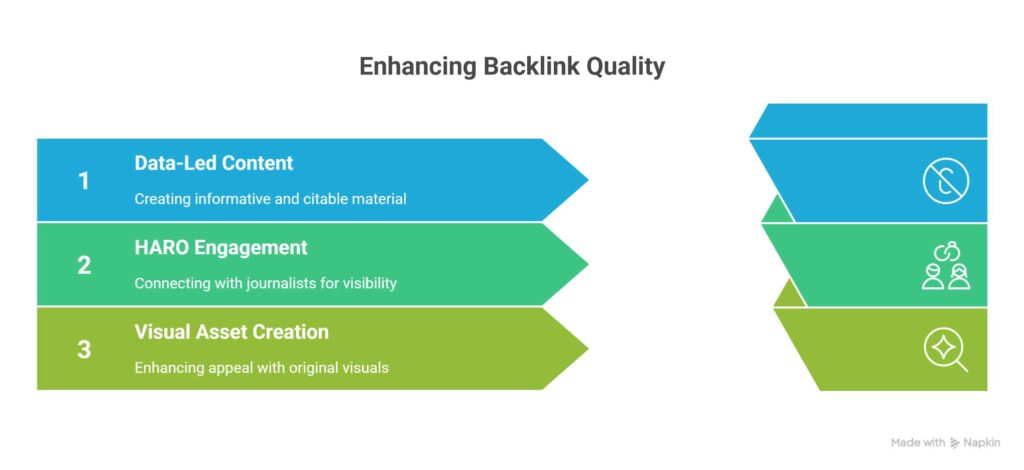
Create data-led content for citations
Original research is the single most effective way to earn high-quality backlinks naturally.
Consider creating:
- Industry surveys with unique insights
- Analysis of internal data revealing interesting trends
- Annual reports on your industry
- Case studies with specific metrics and outcomes
Package this information with clear visualizations and make the data easy to cite. When others need statistics to support their content, your research becomes the go-to source.
Build backlinks using HARO
Help A Reporter Out (HARO) connects journalists with sources. To leverage this for backlinks:
- Sign up for daily queries in your areas of expertise
- Respond quickly with concise, valuable insights
- Include credentials that establish your authority
- Avoid promotional language
Successful HARO pitches often lead to mentions in high-authority publications that would be otherwise difficult to access through traditional outreach.
Earn references using original visual assets
Visual content travels further than text alone. Create shareable assets like:
- Infographics summarizing complex concepts
- Charts and graphs illustrating important data
- Process diagrams explaining complicated workflows
When creating visual assets, include your branding and make them easy to embed with ready-to-use code to generate backlinks naturally.
Put the Checklist into Action for Authority Growth
Building domain authority through off-page SEO isn’t a one-time project but an ongoing process. Start with auditing your current profile, then systematically implement the strategies that make the most sense for your industry and resources.
Set realistic expectations about timeline. Most sites see measurable improvements in domain authority within 3-6 months of consistent effort, but competitive niches may take longer. The good news? While your competitors chase shortcuts, your methodical approach builds sustainable results.
By following this off-page SEO checklist consistently, you’re not just building links. You’re building a digital reputation that establishes your site as an authority worth ranking.
Frequently Asked Questions
What should a backlink audit checklist include?
A comprehensive backlink audit checklist should include analyzing the domain authority of linking sites, checking the relevance of backlinks to your industry, evaluating anchor text distribution for over-optimization, identifying potentially toxic links, and comparing your backlink profile against competitors. You should also check for links from private blog networks (PBNs) and assess whether links come from content-rich pages. The goal is to identify both problematic links and opportunities to improve your overall link profile quality.
How do I know if a backlink is high quality?
A high-quality backlink typically comes from a website with strong domain authority, has relevant topical alignment with your industry, appears naturally within content rather than in footers, comes from a page that receives organic traffic, and has appropriate anchor text that varies naturally. Context matters tremendously. A link from a smaller but highly relevant industry site often provides more value than one from a higher-authority but irrelevant domain.
What are safe link building strategies post-Google updates?
The safest link building strategies focus on earning links rather than building them artificially. Content-driven approaches like creating original research, developing comprehensive resources, and publishing unique insights naturally attract links. Relationship-based strategies like genuine guest posting on relevant sites and building connections with journalists through HARO remain effective and safe. What’s most important is focusing on the value you provide to the linking site’s audience rather than viewing links as the primary goal.
Which tools can I use to track off-page optimization?
For backlink analysis, Ahrefs, Semrush, and Moz provide comprehensive data on link acquisition and domain authority metrics. For brand monitoring, tools like Brand24, Mention, and Google Alerts track unlinked mentions that can be converted to backlinks. Social listening tools such as BuzzSumo help identify content performance. For outreach management, platforms like Pitchbox and BuzzStream streamline the process of building relationships with potential linking partners.
How fast can off-page SEO improve domain authority?
Improvements in domain authority from off-page SEO typically begin showing within 3-6 months of consistent effort. Sites in less competitive niches may see faster results, while highly competitive markets require more sustained work. Your starting point matters. Newer domains generally see more dramatic early improvements than established sites. Domain authority growth is rarely linear. You’ll likely experience plateaus followed by jumps as your site crosses certain thresholds of credibility.

Ridam Khare is an SEO strategist with 7+ years of experience specializing in AI-driven content creation. He helps businesses scale high-quality blogs that rank, engage, and convert.