

Let’s face it – SEO is getting way more complex every year. But here’s the good news: the latest seo automation software tools are changing the game completely.
As Jill Whalen wisely put it, Good SEO work only gets better over time. It’s only search engine tricks that need to keep changing when the ranking algorithms change.
In 2025, these smart platforms are doing in minutes what used to take days. We’re talking about tools that not only track rankings but actually handle technical audits, optimize content, and build strategy – all with minimal human input. Whether you run a small blog or manage enterprise-level SEO campaigns, finding the right automated seo platform can slash your workload while boosting results. So let’s jump into the 10 best SEO automation platforms that are dominating the market in 2025.
What is an SEO automation tool?
An SEO automation tool is a platform that uses AI to handle tasks that would typically require a virtual assistant or junior SEO specialist. These smart systems engage directly with search engines like Google to boost website visibility automatically. The best seo automation software simplifies repetitive processes like keyword tracking, technical audits, and content optimization. Instead of spending hours on manual reporting, these tools free up your team to focus on growth strategies. The main benefits include:
Time-saving efficiencies for examining and adjusting keyword plans
Precision targeting for niche markets
Real-time performance tracking of your website’s SEO status
Top 10 SEO Automation Software in 2025 Compared
Surfer SEO: Best for content planning and briefs
Surfer SEO shines in speeding up content production by automating brief creation and outlines. The platform analyzes top-ranking content to identify patterns and opportunities, then generates detailed briefs in seconds. This automated approach cuts down the planning phase dramatically, letting content teams focus on creativity rather than research.
Pros
- The content editor is a delight, live suggestions, keyword/LSI pointers, structural hints make writing feel less guesswork and more guided.
- You get actionable insights, not vague scores; metrics like word count, heading balance, term usage are tied to clear, measurable tweaks. DemandSage+1
- Strong SERP analysis & competitor comparison help you reverse-engineer what’s working in your niche.
Cons
- Pricing and usage caps bite, many users hit limits on editor credits or audits unless they upgrade.
- Suggestions can feel mechanical or lead to over-optimization if followed too rigidly — you still need a human touch.
- Its feature set isn’t all-inclusive, for deep backlink analysis, full technical SEO audits, or broad keyword gaps, you’ll still lean on other tools.
SE Ranking: Ideal all-in-one SEO automation platform
SE Ranking offers comprehensive automation across the entire SEO workflow. The platform has transformed how teams operate, reducing content creation time from 8 hours to just 3 hours. Its suite of tools handles everything from keyword research to rank tracking and technical audits, making it perfect for agencies and in-house teams needing a unified solution.
Pros
- Excellent value for money: you get a full suite (rank tracking, audits, content tools) without the premium price tag.
- User-friendly interface and smooth onboarding: even new SEO folks find their way quickly.
- Solid automation & reporting features (automated scheduled reports, content briefs, alerts) that reduce manual oversight.
Cons
- Backlink database is weaker/shallow compared to heavyweights like Ahrefs or Majestic.
- Overwhelming data for beginners: too many metrics and modules can confuse non-experts.
- Some features are limited unless you move to higher tiers (or pay extra add-ons) — e.g. advanced audits, keyword grouping.
Zapier: Best for Connecting SEO Tools and Apps
Zapier stands out by connecting your existing SEO tools into seamless automated workflows. Instead of jumping between platforms, Zapier creates “Zaps” that trigger actions across multiple tools. For example, when rankings change, reports can be automatically generated and team notifications sent – all without manual intervention.
Pros
- Flexibility: you can glue together any SEO tools and automate cross-tool workflows (e.g. update your Slack when rankings dip, send reports automatically).
- Low friction: once a Zap is set up, it “just works” in the background, removing repetitive tasks from your plate.
Cons
- Complexity grows fast: managing many Zaps and dependencies can become cumbersome.
- Costs can escalate: with many tasks or premium connectors, pricing becomes steep.
Frase.io: Best automated content optimization tool
Frase.io helps create content that drives traffic from both Google and AI platforms like ChatGPT. Trusted by 30,000+ content creators and marketing teams Frase.io, Frase can generate optimized content briefs in just 6 seconds. The platform analyzes competitors’ content and provides real-time optimization suggestions, helping writers create SEO-friendly content 78% faster.
Pros
- Strong for content planning: it pulls in top results, builds outlines, identifies topic gaps, which accelerates briefing.
- Helps with on-page optimization suggestions (headers, keywords, metadata) in a handy interface.
Cons
- AI output often needs editing: you’ll spend time polishing tone, structure, and factual accuracy.
- Support and upsell issues: some users report unresponsive support and surprise charges in upsells. autoposting.ai+1
Make: Best for Custom SEO Automation Workflows
Make (formerly Integromat) excels in creating custom automation workflows for unique SEO needs. The platform allows you to build visual workflows connecting various tools and data sources. This flexibility makes it ideal for teams with specific processes that off-the-shelf solutions can’t address. According to Statista, 49.1% of professionals worldwide expect AI to boost their website’s search traffic in the next five years.
Pros
- Highly customizable: you can build almost any logic or flow to suit your SEO process, no rigid structure imposed.
- Visual workflow builder makes it easier to see dependencies and debug automations.
Cons
- Upfront setup is heavy: investing time is necessary to map correct triggers, conditions, error handling.
- Maintenance overhead: when underlying tool APIs change (or you switch tools), your workflows may break and need updating.
Rayo: AI-Driven SEO Automation for Content Teams
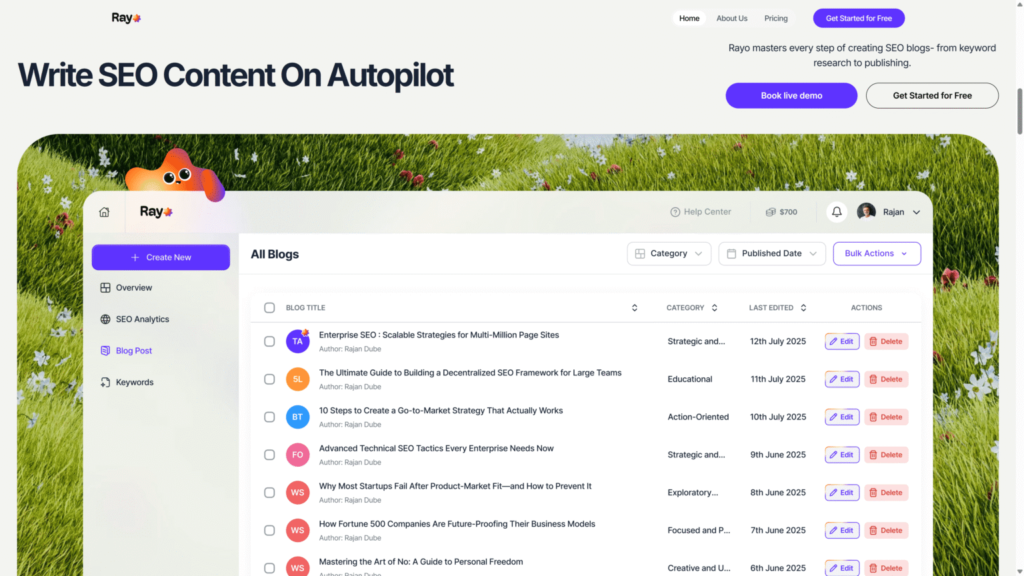
Rayo focuses on content-centric SEO automation, using AI to analyze content gaps and opportunities. The platform automatically identifies underperforming content and suggests improvements based on competitor analysis and search intent. Content teams particularly value its ability to prioritize content updates for maximum impact.
Pros
- Content focus: it narrows in on content gaps and underperforming pages, letting you prioritize high-impact updates.
- AI-driven suggestions: Rayo generates insight based on competitor content and search intent, which can reduce guesswork.
Cons
- Narrower scope: because it’s content-centered, you’ll likely still need other tools for backlinks, technical SEO, crawling.
ContentShake AI (by Semrush): Ideal for freelancers
At $60/month, ContentShake AI combines Semrush’s powerful SEO data with AI content creation. Freelancers love its ability to find target keywords, analyze SERPs, and generate optimized content in one place. The tool even includes AI image generation and one-click WordPress publishing, streamlining the entire content process.
Pros
- Integrated with Semrush’s data: you get access to SERP data, keyword metrics, domain insights behind the scenes.
- End-to-end flow: from keyword to content to WordPress publishing, many steps are built-in, reducing tool switching.
Cons
- Possible limitations in AI creativity: content might feel templated or generic without heavy editing.
- Cost vs volume: for large content pipelines, costs can rise and usage caps might limit scale.
Screpy: Low-budget automated SEO checker
Screpy offers powerful SEO monitoring and automation at a fraction of competitors’ prices. The platform helps you quickly analyze your site’s SEO situation, identifying strengths and weaknesses without complex setups. For small businesses with limited budgets, Screpy provides essential automation without breaking the bank.
Pros
- Lightweight & no-nonsense: you get essential SEO monitoring and alerts without overwhelming complexity.
- Good for small budgets: delivers automation and checks without premium pricing.
Cons
- Limited depth: you won’t get enterprise features or deep audits; it’s “just enough” for many small sites.
- Less mature integrations or support: fewer third-party connectors, fewer advanced modules compared to established tools.
Diib: Strong mix of automation and tracking features
Diib combines automated monitoring with actionable insights, helping users understand not just what’s happening but why. The platform stands out with its simplified dashboards and automated alerts that notify you of significant changes or opportunities, making it perfect for busy marketers who need clarity without complexity.
Pros
- Clear dashboards & alerts: the UI is simplified so you see what matters and get notified when things change.
- Mix of automation + explanation: not just signals, but “why this matters” context helps non-SEO users.
Cons
- Not as deep: the automated insights sometimes feel basic or generic for advanced users.
- Data
JetOctopus: Advanced enterprise-level SEO automation
JetOctopus delivers industrial-strength automation for large websites and enterprise SEO teams. Its log analyzer and advanced crawling capabilities can handle millions of pages efficiently. The platform excels at identifying technical issues and providing automated solutions, making it the go-to for large-scale SEO operations.
Pros
- Scalable for big sites: its crawler/log analysis is built to handle millions of pages efficiently. gigradar.io+2Reddit+2
- Technical SEO power: excels in detecting crawl issues, log anomalies, indexing problems.
Cons
- Steep learning curve: the interface and data outputs demand SEO technical knowledge to interpret correctly.
- Limited non-technical features: it’s strong in crawling/logs, but less helpful in content ideation, keyword research, or editorial workflows.
Key Comparison Factors to Consider
Ease of use and interface flexibility comparisons
When evaluating seo automation platforms, user interface matters tremendously. Surfer SEO and Frase.io offer the most intuitive designs for content-focused teams, while SE Ranking provides comprehensive features without overwhelming users. Ahrefs stands out for its vast database of backlinks and keywords, making it versatile for repetitive SEO tasks. Consider your team’s technical expertise – tools like Diib and Screpy prioritize simplicity, making them accessible even to SEO beginners.
Automation depth for on-page and technical SEO tasks
The real value of an automated seo platform lies in how much manual work it eliminates. ContentShake AI excels at automating content creation and optimization, while JetOctopus offers the deepest technical SEO automation. SE Ranking provides the most balanced automation across both areas. For pure technical SEO automation, tools like Screpy can automatically identify and prioritize issues, saving hours of manual auditing.
Pricing and value-for-money breakdown for platforms
Budget considerations vary widely among these tools. Screpy starts under $50/month, making it accessible for small businesses. Mid-range options like Frase.io ($45-$115/month) and ContentShake AI ($60/month) offer strong value for content teams. Enterprise solutions like JetOctopus and SE Ranking require larger investments but deliver comprehensive automation that can replace multiple point solutions.
Conclusion
The right seo automation software can transform your SEO strategy, saving countless hours while improving results. Your choice should align with your specific needs – content-focused teams will benefit most from Surfer SEO or Frase.io, while technical teams might prefer JetOctopus or SE Ranking. By 2025, automation isn’t just a luxury – it’s essential for competitive SEO.
FAQs
Which SEO automation software is best for small businesses?
Screpy offers the best balance of affordability and functionality for small businesses, with Diib as a close second. Both tools provide essential automation features without overwhelming complexity or cost.
Are SEO automation platforms effective for content creation?
Absolutely! Tools like Frase.io, Surfer SEO, and ContentShake AI have revolutionized content creation with AI-driven briefs and optimization. Users report cutting content production time by up to 78% while maintaining or improving quality.
What is the most affordable automated SEO platform in 2025?
Screpy remains the most budget-friendly option with comprehensive features at the lowest price point. For content-specific automation, Frase.io’s starter plan provides excellent value at $45/month.
Is SEO automation software better than manual optimization?
It’s not about replacing manual optimization but enhancing it. The best results come from combining automated processes for repetitive tasks with human expertise for strategy and creative decisions.
Can a SEO automation platform replace a full-time SEO specialist?
No automation tool can fully replace human expertise. However, these platforms can handle 60-80% of routine SEO tasks, allowing specialists to focus on strategy and high-impact activities rather than repetitive work.

Ridam Khare is an SEO strategist with 7+ years of experience specializing in AI-driven content creation. He helps businesses scale high-quality blogs that rank, engage, and convert.