
Most cybersecurity firms approach SEO like they’re building a fortress – everything locked down tight, minimal content exposure, paranoid about revealing too much. Here’s the thing: that defensive mindset is killing your visibility. The companies dominating search results aren’t the ones playing it safe with generic “we protect your data” messaging. They’re the ones bold enough to share real security insights and actually demonstrate their expertise in public.
Core SEO Strategies for Cyber Security Companies
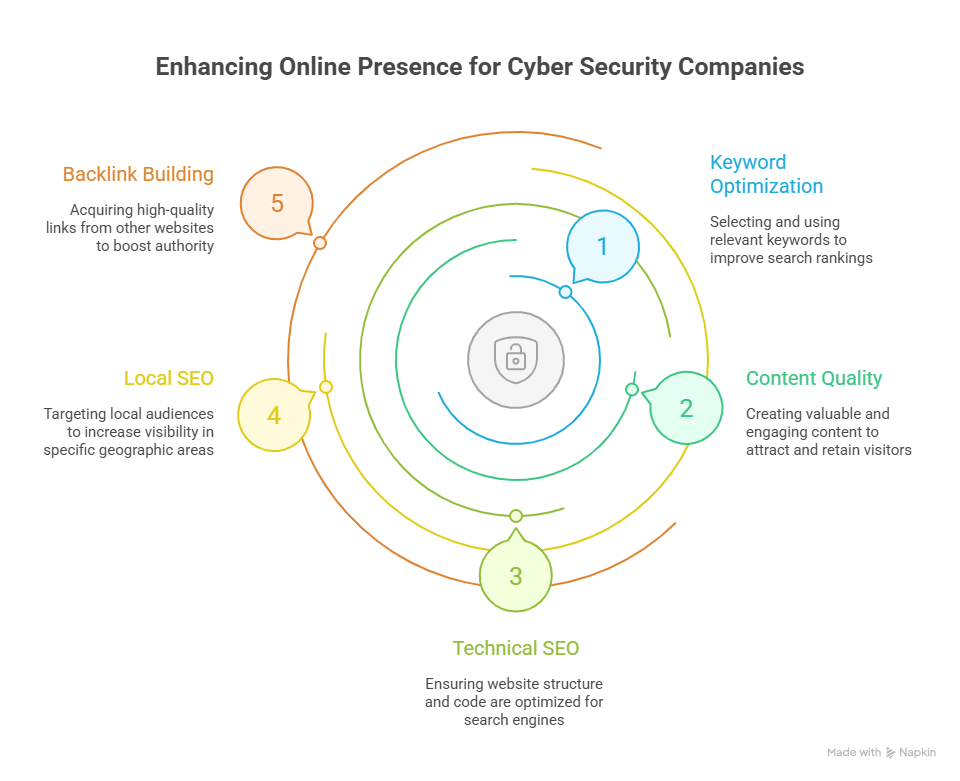
Target Long-Tail Security Keywords with High Commercial Intent
Forget competing for “cybersecurity services” – that ship has sailed. The real opportunity lies in those specific, problem-focused searches your prospects make at 2 AM when their systems are under attack. Think searches like “ransomware recovery services Chicago” or “HIPAA compliance audit consulting.” These longer phrases convert at 2.5 times the rate of generic terms. Why? Because someone searching for these isn’t just browsing – they have budget and urgency.
Start by mining your support tickets and sales calls for the exact language clients use when describing their security nightmares. You’ll find gold like “why is our firewall blocking legitimate traffic” or “how to pass SOC 2 audit quickly.” These aren’t sexy keywords. But they’re profitable ones.
Create Technical Security Content That Demonstrates Expertise
Here’s what drives me crazy: security companies publishing fluff pieces about “the importance of strong passwords” while their competitors are breaking down zero-day exploits and sharing incident response playbooks. Guess who Google trusts more?
Your content needs technical meat on the bones. Write detailed breakdowns of recent breaches (naming no victims, of course), publish your penetration testing methodologies, share sanitized examples from your incident response cases. One security firm I know published their internal checklist for responding to a ransomware attack – complete with command-line tools and decision trees. That single piece brought them 47 qualified leads in three months.
But here’s the catch – you still need to make it digestible. Use analogies (comparing network segmentation to fire doors in a building), include diagrams, and always explain the business impact alongside the technical details.
Build Authority Through Security Industry Link Partnerships
Link building in cybersecurity is its own beast. You can’t just guest post anywhere – you need credibility from the right sources. Focus on three tiers:
-
Tier 1: Security research organizations, CERT teams, and industry bodies (these are gold but hard to get)
-
Tier 2: Security vendors you partner with, compliance organizations, and tech publications
-
Tier 3: Client testimonials, case studies, and local business associations
The secret? Contribute real value first. Submit vulnerability disclosures, share threat intelligence, and participate in bug bounty programs. These activities naturally generate authoritative links without you having to beg for them.
Optimize for Security Compliance and Trust Signals
Your prospects aren’t just evaluating your SEO – they’re evaluating your security posture through your website. Every trust signal matters. Display your certifications prominently (ISO 27001, SOC 2, whatever you’ve got), implement proper SSL certificates, show your physical address, list your key personnel with LinkedIn profiles.
Schema markup isn’t optional here. Mark up your certifications, your service areas, your organization type. Google needs to understand you’re a legitimate security provider, not another fly-by-night operation. One client saw a 34% increase in click-through rates just by properly marking up their security certifications and displaying them in rich snippets.
Cybersecurity SEO Best Practices for Maximum Visibility
Structure Content Around Security Pain Points and Solutions
Stop organizing your content by service type. Nobody wakes up thinking “I need a SIEM solution.” They wake up thinking “Why can’t I see what’s happening on my network?” or “How do I prove compliance to auditors?”
Structure your content architecture around problems and outcomes:
|
Problem-Focused Page |
Traditional Service Page |
Why It Works Better |
|---|---|---|
|
“Detect Insider Threats Before Data Exfiltration” |
“User Behavior Analytics Services” |
Matches actual search intent and emotional state |
|
“Pass Your PCI Compliance Audit First Time” |
“Compliance Consulting” |
Specific outcome with clear value proposition |
|
“Recover From Ransomware in 24 Hours” |
“Incident Response Services” |
Addresses urgency and sets expectations |
Each problem-focused page should follow this structure: validate the problem (show you understand their pain), explain the risks of inaction, present your solution approach, and provide proof through case studies or statistics. Simple formula. Massive impact.
Implement Schema Markup for Security Services
Most security companies completely ignore schema markup, leaving money on the table. You need LocalBusiness schema with your security-specific service types, FAQ schema for your educational content, and HowTo schema for your security guides.
Here’s a quick win: implement SecurityScreening schema on your service pages. It’s technically for physical security but Google often displays it for cybersecurity services too. Include your certifications in the Organization schema – particularly your DUNS number if you work with government contracts. These small tweaks can push you above competitors in local pack results.
Develop Location-Based SEO for Regional Security Markets
Even if you serve clients globally, local SEO for cyber security still matters. Why? Because 73% of security breaches prompt companies to seek local incident response teams first. They want someone who can be on-site if needed.
Create location pages that go beyond “Cybersecurity Services in [City]” garbage. Include regional compliance requirements (California has CCPA, healthcare facilities need HIPAA), local case studies, team member profiles from that region, and specific industries you serve there. If you protect three hospitals in Dallas, say so. That specificity builds trust and helps you rank for “[industry] cybersecurity [location]” searches.
Maximizing Your Cybersecurity Firm’s Search Visibility
The cybersecurity companies winning at SEO aren’t playing defense – they’re going on the offensive with bold, technically rich content that actually helps their prospects. They’re not afraid to share real expertise because they know that demonstrating competence publicly is the best sales tool they have.
Remember this: your competitors are either too paranoid to share real insights or too lazy to create quality content. That gap? That’s your opportunity.
Start with one technical guide that solves a real problem your clients face. Optimize it properly, promote it to the right security communities, and watch what happens. Once you see the quality of leads that come from genuine thought leadership content, you’ll never go back to generic “cybersecurity best practices” posts again.
FAQs
What are the most effective keywords for cybersecurity SEO?
The most effective keywords combine specific security threats with commercial intent. Think “ransomware negotiation services,” “GDPR compliance audit tools,” or “zero trust architecture implementation.” Industry-specific combinations work exceptionally well – “healthcare ransomware protection” converts better than generic “ransomware protection.” Focus on long-tail keywords that indicate buying intent or urgent problems rather than informational searches.
How long does it take to see SEO results for a cybersecurity website?
Expect 4-6 months for initial traction, with meaningful results typically appearing around month 8-12. Security content takes longer to rank because Google applies extra scrutiny to YMYL (Your Money or Your Life) topics. Technical, authoritative content can actually rank faster (3-4 months) if you’re targeting specific, less competitive security niches. The key is consistency – publishing one deep technical piece monthly beats sporadic content dumps.
Should cybersecurity companies focus on local or national SEO?
Both, but start local. Even national firms get 40% of their leads from local searches when companies need on-site incident response or face regional compliance requirements. Build your local foundation first (city pages, local citations, regional case studies), then expand nationally through technical content and thought leadership. Don’t make the mistake of ignoring local SEO because you “serve everyone” – that’s leaving qualified leads for your competitors.
How important is technical SEO for security company websites?
Critical. Poor technical SEO on a security website is like having a broken lock on your front door – it destroys credibility instantly. Page speed, proper SSL implementation, secure hosting, and clean code aren’t just ranking factors; they’re trust signals. Google holds security sites to higher technical standards. Fix your Core Web Vitals, implement proper security headers, and ensure your site practices what you preach. One misconfigured certificate or slow-loading page can cost you more than just rankings – it costs you credibility.

Ridam Khare is an SEO strategist with 7+ years of experience specializing in AI-driven content creation. He helps businesses scale high-quality blogs that rank, engage, and convert.