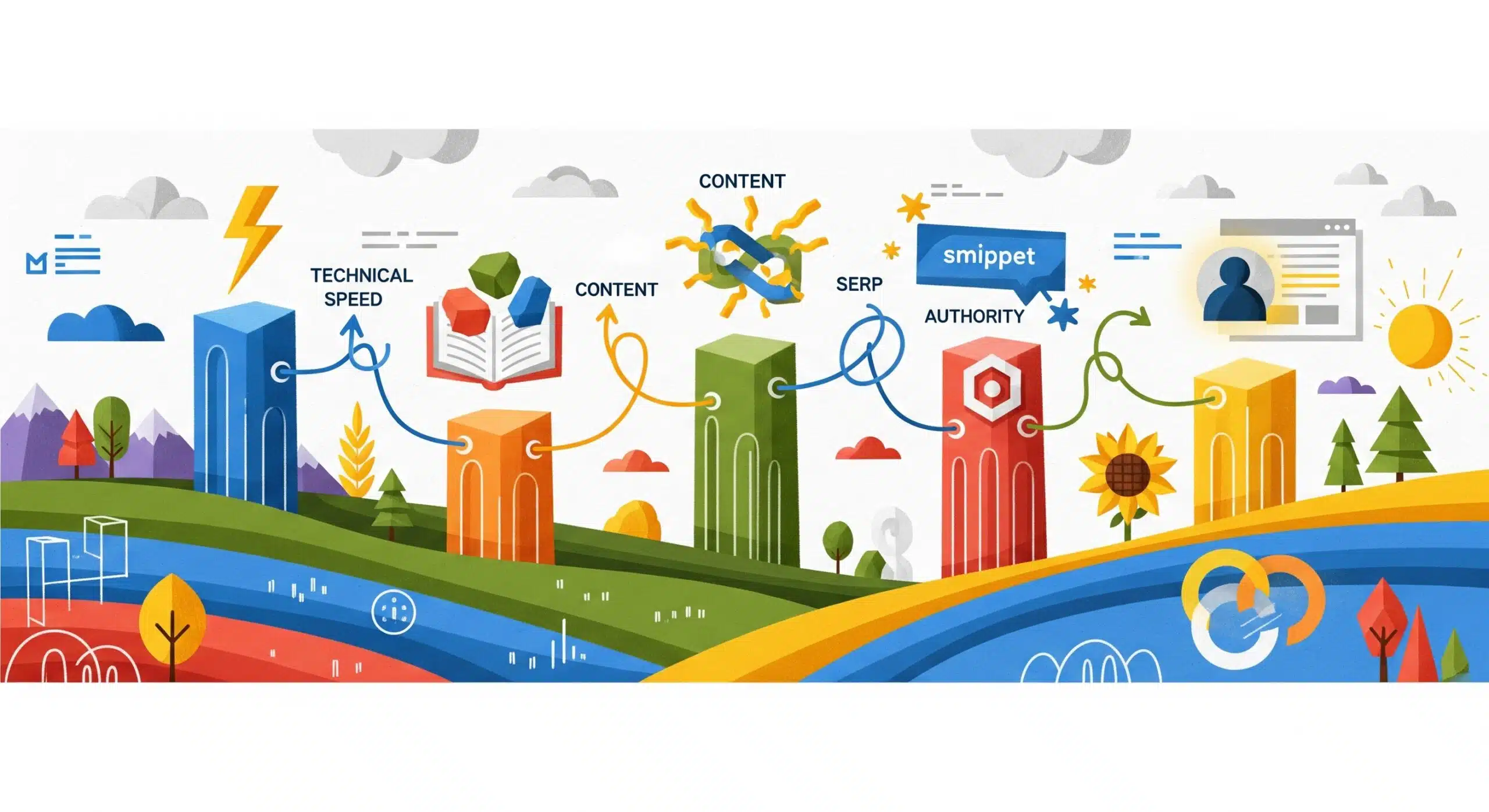
The classic SEO playbook says to focus on keywords and backlinks first. That advice worked in 2015. Today, while everyone’s chasing the same tired tactics, the brands actually winning in organic search have figured out something different – they’ve built their entire SEO strategy around five interconnected pillars that Google’s algorithm now rewards above everything else.
The 5 Essential SERP SEO Pillars to Master for Top Rankings
1. Modern Technical SEO Fundamentals
Forget what you learned about technical SEO five years ago. The modern technical SEO pillars that actually matter now revolve around one thing: speed and accessibility at scale. Your site needs to load in under 2.3 seconds on mobile (not the “under 3 seconds” everyone still quotes) and pass Core Web Vitals with green scores across the board.
But here’s what drives me crazy – most brands still obsess over their homepage speed while ignoring the 500 blog posts that actually drive their traffic. Every single page needs optimization. Not just the pretty ones.
The real game-changer? JavaScript rendering. If Google can’t render your JavaScript-heavy pages within 5 seconds, you’re essentially invisible. Check your coverage report in Search Console. Those “Discovered – currently not indexed” pages? That’s Google telling you your technical foundation is broken.
2. Strategic Content Creation and Optimization
Content strategy used to mean pumping out 500-word blog posts targeting long-tail keywords. Now it’s about building topical authority through comprehensive content hubs that answer every possible question around a topic. Think Wikipedia, not blog spam.
The brands dominating SERPs right now follow a simple formula: one pillar page (3,000+ words) supported by 10-15 cluster pages (1,500+ words each), all interlinked and targeting related search intents. They’re not chasing keywords. They’re owning topics.
Want proof? Search any competitive term and look at the top three results. Notice how they all cover the topic from multiple angles in a single piece? That’s not coincidence.
3. Targeted SERP Feature Optimization
Stop optimizing for blue links. They’re dying. The real estate that matters now includes featured snippets, People Also Ask boxes, knowledge panels, and (increasingly) AI Overviews. Your targeted SERP SEO pillars need to focus on these rich results because that’s where 62% of clicks now happen.
The hack nobody talks about: structure your content to answer questions in 40-60 word paragraphs immediately after H2 or H3 headers. Use lists with exactly 5-8 items. Include a summary table near the top of your content. These formats trigger featured snippets like clockwork.
4. Authority Building Through Off-Page Signals
Everyone knows backlinks matter, but the game has changed. Google’s looking at brand signals now – unlinked mentions, search volume for your brand name, social proof, and what they call “entity recognition.” Basically, does Google understand that you’re a real brand with real expertise?
The fastest way to build authority in 2024: get featured in industry publications not for backlinks but for brand mentions. Create original research that journalists actually want to cite. Show up consistently in your industry’s conversations. Links follow authority, not the other way around.
5. User Experience and Core Web Vitals
Remember when UX meant having a mobile-responsive design? Quaint. Now Google measures everything – how quickly users can interact with your page (First Input Delay), how much your content shifts while loading (Cumulative Layout Shift), and whether people actually engage with your content or bounce back to search results.
The metric that matters most (and nobody tracks): dwell time. If someone spends 4+ minutes on your page, Google notices. But if they’re back searching within 30 seconds? You’re toast.
Simple fix: front-load value. Answer the searcher’s question in the first 100 words, then expand with details. Most sites bury the answer under 500 words of “context” nobody asked for.
How to Implement Each SERP SEO Pillar for Maximum Impact
Advanced Schema Markup Strategies for Rich Results
Schema markup is your secret weapon for standing out in SERPs, yet 70% of sites either don’t use it or implement it wrong. The basics everyone knows: Organization, Article, Product schemas. The ones actually driving results: HowTo, FAQ, and VideoObject schemas.
Here’s the implementation that works:
| Schema Type | Best Use Case | Expected CTR Increase |
|---|---|---|
| FAQ Schema | Informational content | +28% |
| HowTo Schema | Tutorial content | +35% |
| Review Schema | Product pages | +22% |
| Video Schema | Any page with video | +41% |
Pro tip: Layer multiple schemas. A tutorial page can use HowTo, FAQ, and Video schemas simultaneously. Just keep it relevant and honest – Google’s very good at detecting schema spam.
Building Topic Clusters for Semantic Authority
Topic clusters aren’t just internal linking. They’re about creating a web of content so comprehensive that Google has no choice but to see you as the authority. Start with your pillar page – this should be your most comprehensive resource on the topic, typically 3,000-5,000 words.
Then build your cluster pages around user intent:
- Informational clusters: “What is,” “How to,” “Why” content
- Comparison clusters: “vs” pages, alternatives, reviews
- Transactional clusters: Pricing, features, case studies
Link every cluster page back to your pillar and to 2-3 related cluster pages. Not randomly – based on user journey. What would someone reading about “email marketing basics” want to know next?
Optimizing for AI Overviews and Featured Snippets
AI Overviews are eating traditional featured snippets for breakfast. The difference? AI Overviews pull from multiple sources and synthesize information. You can’t optimize for them the old way.
What works now: comprehensive, nuanced content that covers edge cases and provides original insights. Google’s AI is looking for information it can’t find elsewhere. Give it data, statistics, expert quotes, and most importantly – clear, structured information hierarchy.
Format your content like this:
Lead with a definition or direct answer (40-60 words)
Follow with supporting evidence or examples
Include relevant statistics or data points
Close with practical application or next steps
Sound formulaic? It is. But it works.
Essential Metrics to Track Pillar Performance
Most teams track rankings and traffic. That’s like watching the scoreboard but not the game. The metrics that actually predict SERP success:
- Impression share growth – Are you showing up for more queries?
- Click-through rate by position – Is your content compelling?
- Average engagement time – Do people actually read your content?
- Return visitor rate – Does your content build loyalty?
- SERP feature ownership – How many rich results do you own?
Track these weekly, not monthly. SEO moves fast now. By the time monthly reports show a problem, you’ve already lost ground to competitors who monitor daily.
Making Your SERP SEO Pillars Work Together
Here’s the truth nobody wants to admit: you can’t master all five SERP SEO pillars at once. Every brand that’s tried has failed. The ones succeeding pick one pillar, nail it completely, then layer in the next.
Start with technical SEO if you’re an established site with existing content. Fix your foundation first. For new sites? Begin with strategic content creation and build authority from day one. E-commerce? SERP features should be your obsession.
The magic happens when these pillars reinforce each other. Great technical SEO makes your content load fast and rank better. Better rankings build authority. Authority earns featured snippets. Featured snippets improve CTR and user signals. It’s a flywheel, not a checklist.
Most brands give up after three months because they don’t see movement. The ones that win? They commit to the full system for 12 months minimum. They track the right metrics and adjust based on data not hunches. They understand that reliable organic SEO pillars aren’t built overnight but once established, they become nearly impossible for competitors to overcome.
What’s your move? Pick your first pillar and commit. The SERPs won’t wait.
FAQs
Which SERP SEO pillar should brands prioritize first?
Start with technical SEO if you have existing content that’s underperforming. If your site loads slowly or has indexing issues, nothing else matters until that’s fixed. New sites should prioritize strategic content creation first since you need something worth ranking before worrying about the technical details.
How do modern technical SEO pillars differ from traditional ones?
Traditional technical SEO focused on XML sitemaps, meta tags, and basic crawlability. Modern technical SEO is about JavaScript rendering, Core Web Vitals, mobile-first indexing, and structured data implementation. The bar is much higher – what passed in 2018 fails today.
What role does E-E-A-T play in reliable organic SEO pillars?
E-E-A-T (Experience, Expertise, Authoritativeness, Trustworthiness) is now the foundation of content quality assessment. Google wants to see author bylines with real credentials, comprehensive about pages, clear editorial guidelines, and actual first-hand experience with topics you’re covering. It’s not a ranking factor. Its what makes ranking factors work.
How often should brands audit their SERP SEO pillars?
Run a technical audit monthly, content audit quarterly, and full pillar assessment twice yearly. But here’s the key – monitor your core metrics weekly. The audit tells you what’s broken. The weekly metrics tell you what’s breaking. Catch issues before they become

Ridam Khare is an SEO strategist with 7+ years of experience specializing in AI-driven content creation. He helps businesses scale high-quality blogs that rank, engage, and convert.