
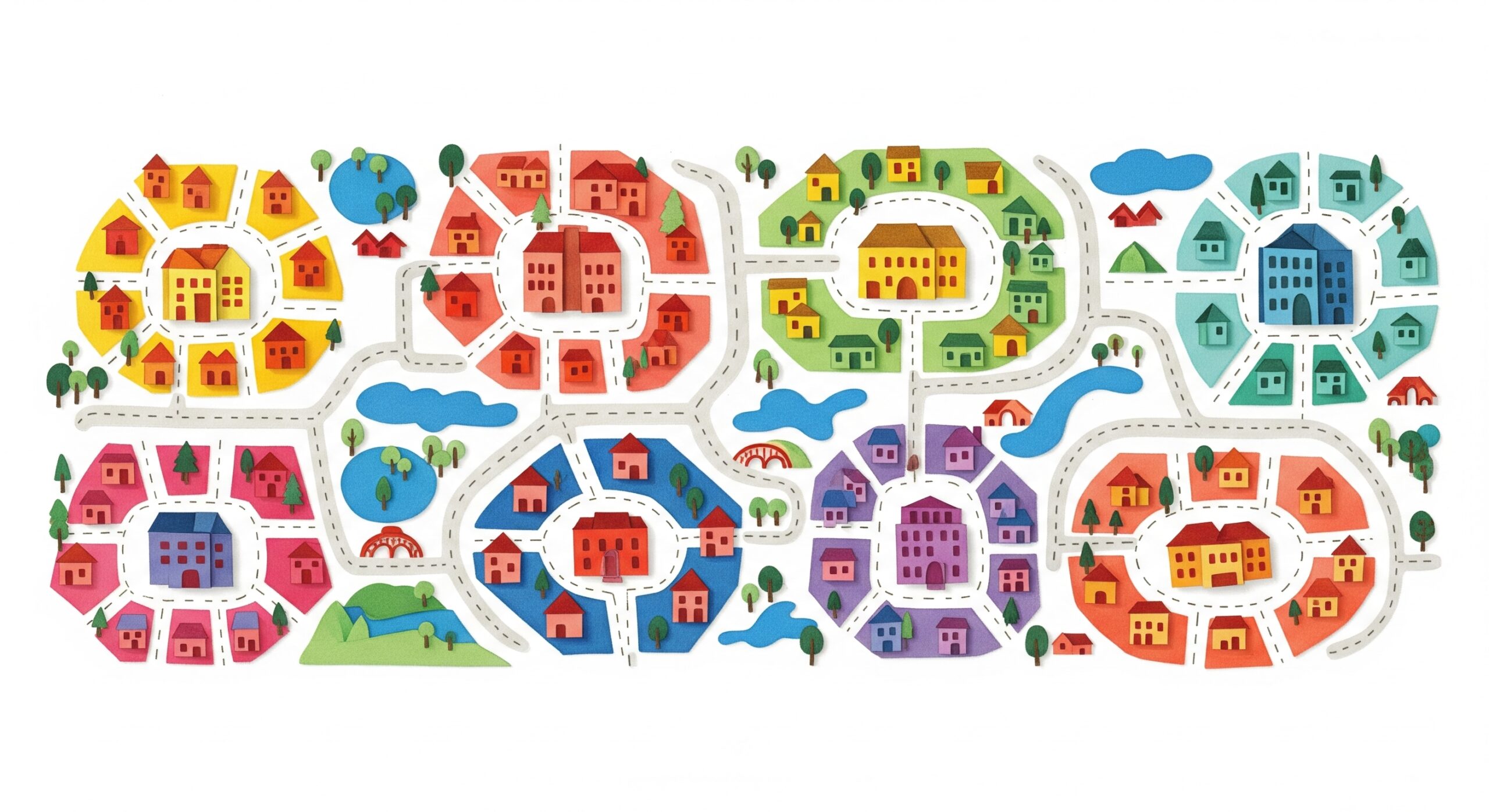
Most SaaS companies treat their content like a library – neat rows of individual articles that never talk to each other. Meanwhile, the companies actually winning at organic growth? They’re building interconnected content empires where every piece reinforces the next. The difference isn’t more content. It’s smarter architecture.
Core Topic Cluster Strategies for SaaS Companies
Think of your content strategy as building a city, not just houses. Each topic cluster for SaaS represents a neighborhood with its own character and purpose, but they’re all connected by strategic roads (internal links) that guide visitors exactly where they need to go. The magic happens when you stop thinking about individual blog posts and start thinking about content ecosystems.
Product Feature Clusters
Your product features deserve more than a single landing page buried in your navigation. Build an entire content universe around each major feature – tutorials and use cases and comparisons and troubleshooting guides all orbiting that central pillar page. When someone searches for “automated workflow software,” they shouldn’t just find your feature page. They should stumble into an entire knowledge base that positions you as the definitive expert.
Here’s what most teams miss: each feature cluster should mirror how customers actually think about that capability. If your automation feature saves time, don’t just write about the feature itself. Write about time management strategies and productivity hacks and workflow optimization. Make the cluster bigger than the feature.
Use Case Clusters
Stop writing generic “How Our Product Works” content. Nobody cares. What they care about is solving their specific problem in their specific context with their specific constraints.
Build clusters around concrete use cases:
- Marketing teams using your tool for campaign management
- Sales teams leveraging it for pipeline tracking
- Operations teams applying it to process optimization
- Customer success teams implementing it for retention
Each use case becomes a mini-site within your site. The pillar page presents the high-level solution. Supporting content dives into implementation details and best practices and case studies and templates. Suddenly you’re not just ranking for your product name – you’re ranking for every problem your product solves.
Industry Solution Clusters
Different industries speak different languages. A content architecture for SaaS that ignores this reality is leaving money on the table. Your healthcare customers don’t care about your retail case studies. Your enterprise clients don’t want to see SMB pricing.
Create dedicated clusters for each core industry you serve. But here’s the kicker – don’t just slap an industry label on generic content. Actually understand and address industry-specific pain points and regulations and workflows. When a healthcare IT manager lands on your healthcare cluster, they should immediately think “Finally, someone who gets it.”
Problem-Solution Clusters
Most SaaS companies make a fatal mistake. They assume prospects already know they need their solution. Reality check: most of your potential customers are still trying to understand their problem.
Build clusters that start with the problem, not your product:
| Problem Focus | Content Approach |
|---|---|
| Data silos | Why they exist, costs, integration challenges |
| Manual processes | Hidden costs, scaling issues, error rates |
| Poor visibility | Decision delays, missed opportunities, reporting gaps |
| Team misalignment | Communication breakdowns, duplicated effort, accountability |
Only after you’ve thoroughly explored the problem do you introduce your solution. This approach captures searchers at every stage of awareness.
Comparison and Alternative Clusters
Your prospects are comparing you to competitors whether you acknowledge it or not. So own the conversation. Create comprehensive comparison clusters that actually help buyers make decisions instead of just claiming you’re better at everything.
The secret? Be genuinely helpful. Point out scenarios where a competitor might actually be a better fit. Sounds crazy? It builds trust like nothing else. When you’re honest about your limitations, people believe you about your strengths.
Building Your SaaS Content Architecture
Architecture beats volume every time. You could publish a thousand blog posts, but if they’re not strategically connected, you’re just creating noise. The companies dominating SaaS search results understand this. They’re not writing more – they’re building better.
Mapping Pillar Pages to Customer Journey Stages
Your pillar pages shouldn’t exist in isolation. Each one should map to a specific stage in your customer’s journey. Early-stage pillars focus on problem education. Mid-stage pillars compare solutions. Late-stage pillars address implementation and success.
Picture it like this: someone discovers your problem-focused pillar through search. They read three supporting articles. Your internal links guide them to a solution-comparison pillar. From there, they explore feature-specific content. By the time they hit your demo page, they’ve consumed 10+ pieces of content that all reinforce the same message. That’s not luck. That’s architecture.
But what makes a great pillar page for each stage?
Awareness Stage: 3,000+ word guides that become the definitive resource on a problem
Consideration Stage: Detailed comparisons and methodology explanations
Decision Stage: Implementation guides and ROI calculators
Creating Supporting Content Networks
Supporting content isn’t filler – it’s the connective tissue that makes your topic cluster strategy for SaaS actually work. Each piece should serve a specific purpose in your cluster ecosystem.
Think about supporting content in three tiers. Tier 1 directly supports your pillar with detailed explorations of subtopics. Tier 2 provides examples and case studies and templates. Tier 3 answers specific questions and objections. Every piece links back to the pillar and to relevant siblings in the cluster.
The mistake everyone makes? Random internal linking based on keywords. Strategic linking based on user intent and journey progression – that’s where the real power lies.
Internal Linking Structure for Content Hubs
Your internal linking shouldn’t look like spaghetti thrown at a wall. It should look like a subway map – clear routes between related destinations with logical transfer points.
Start with hub pages that act as navigation centers. Each hub links to all pillars in that topic area. Pillars link to their supporting content and related pillars. Supporting content links back to its pillar and sideways to related supporting pieces. Never more than three clicks from any page to any related page.
✓ Every pillar page has 5-10 supporting articles
✓ Each supporting article links to 2-3 related pieces
✓ Hub pages provide bird’s-eye navigation
✓ Contextual links connect related clusters
✓ Footer and sidebar links reinforce main paths
Simple, right? Yet most SaaS sites have internal linking that looks like it was designed by a caffeinated squirrel.
Maximizing SaaS Growth Through Strategic Content Clusters
After building content clusters for dozens of SaaS companies, one pattern emerges. The winners don’t just create clusters – they evolve them. They track which paths users actually take through their content. They identify where people drop off and where they convert. Then they optimize those paths like they’re A/B testing landing pages.
Your content hubs for SaaS should be living systems, not static monuments. Add new supporting content based on emerging search queries. Update pillars when the market shifts. Prune underperforming pieces that dilute your authority. This isn’t a “set it and forget it” strategy. It’s an ongoing evolution.
The real test? Can someone land on any piece of content in your cluster and find their way to becoming a customer without hitting a dead end? If not, your architecture needs work.
FAQs
How many topic clusters should a SaaS company start with?
Start with three to five core clusters that align with your main value propositions or customer segments. Better to build three exceptional clusters than ten mediocre ones. You can always expand once your initial clusters are generating results.
What’s the difference between a pillar page and a cluster page?
Pillar pages are comprehensive guides (usually 2,000+ words) that cover a broad topic thoroughly. Cluster pages are supporting content pieces that explore specific subtopics in detail, all linking back to the main pillar. Think of the pillar as the textbook and cluster pages as individual chapters.
How long should pillar content be for SaaS topic clusters?
Aim for 2,500-5,000 words for most pillar pages. But length isn’t the goal – comprehensive coverage is. Some technical topics might need 7,000+ words. Some straightforward concepts might be complete at 2,000. Let the topic complexity guide the length.
Can topic clusters work for technical SaaS products?
Absolutely. Technical products actually benefit more from cluster strategies because you can create separate clusters for different technical depths – beginner overviews, implementation guides, API documentation, and advanced optimization techniques. Each cluster serves a different audience need.
How do topic clusters impact SaaS conversion rates?
Well-executed clusters typically increase organic conversion rates by 30-50% because visitors consume multiple pieces of content before converting. They arrive more educated and qualified. The key is ensuring your clusters guide readers naturally toward conversion points without being pushy.

Ridam Khare is an SEO strategist with 7+ years of experience specializing in AI-driven content creation. He helps businesses scale high-quality blogs that rank, engage, and convert.