Everyone’s chasing the same SEO playbook from 2020 – keywords, backlinks, content clusters. Meanwhile, Google’s been quietly building something entirely different. The Knowledge Graph has transformed from a search feature into the backbone of how Google understands the internet, and most SEO strategies haven’t caught up yet.
Think about the last time you searched for a business or person. Did you scroll through blue links, or did you glance at that information-rich panel on the right? That’s the Knowledge Graph at work. Its basically reshaping how users interact with search results, and if you’re not optimizing for it in 2025, you’re playing yesterday’s game.
Here’s what makes knowledge graph optimization SEO strategy different: instead of just telling Google what your content is about through keywords, you’re teaching it to understand your brand as an entity – with relationships, attributes, and connections that machines can process and humans can trust. It’s the difference between being a webpage and being a recognized authority.
Top Knowledge Graph Optimization Strategies for 2025
The landscape has shifted dramatically. Voice search queries now account for nearly 40% of all searches, AI overviews are pulling directly from structured data, and Google’s algorithm increasingly favors entities over keywords. Sound overwhelming? Let’s break down exactly what works.
1. Implement Schema Markup for Entity Recognition
Schema markup isn’t new, but the way Google uses it has fundamentally changed. You’re not just marking up products and reviews anymore – you’re defining your entire business as a interconnected web of entities. Start with Organization schema at the homepage level, then branch into Person schema for key team members and Product or Service schema for your offerings. The trick is linking these together with sameAs properties and mentions.
Most sites stop at basic schema. Don’t. Layer in Event schema for webinars, FAQ schema for support pages, and HowTo schema for tutorials. Each piece reinforces your entity status.
2. Build Internal Knowledge Graph Infrastructure
Before Google can understand your knowledge graph, you need one. Map out every entity in your business ecosystem – products, people, locations, concepts – and document their relationships. A SaaS company might connect their CEO (Person) to their company (Organization) to their main product (SoftwareApplication) to the problems it solves (Thing).
Create dedicated entity pages for each major component. Not product pages – entity pages. These should comprehensively describe what something is, not just sell it. Think Wikipedia, not Amazon.
3. Connect Existing Entities to Google Knowledge Graph
Your brand doesn’t exist in isolation. Link to authoritative external entities through your content and schema. Mention industry associations you belong to, certifications you hold, notable clients (with permission), and established concepts you work with.
Use Wikidata IDs in your schema where possible. If your founder has a Wikipedia page, reference it. If your company is listed in industry databases, connect those dots. Google trusts entities it already knows, and association builds authority.
4. Optimize for Voice Search and Conversational AI
Voice queries are longer, more conversational, and entity-focused. “What’s the best CRM for small law firms in Chicago?” beats “CRM software” in the voice search world. Structure your content to answer these natural language queries directly.
Create content that speaks to entity relationships: “Our CRM (Product) was designed by former lawyers (Person entities) specifically for small practices (Organization type) in urban markets (Location entities).” This isn’t keyword stuffing – it’s entity weaving.
5. Create Content Knowledge Graph Architecture
Stop thinking in terms of blog categories and start thinking in entity clusters. Each piece of content should clearly relate to specific entities and their relationships. A blog post about tax software features connects to the software entity, the feature entities, the problem entities they solve, and the user type entities who benefit.
Build topic authority through entity depth, not keyword variations. Instead of 10 posts about “tax software tips,” create comprehensive resources about specific tax scenarios, each linked to relevant law entities, date entities (tax years), and process entities.
6. Establish Entity Authority Through Structured Data
Authority comes from consistency and comprehensiveness. Every mention of an entity across your site should have consistent structured data. Your CEO’s name, title, and social profiles should be identical in every instance. Product specifications, prices, and features need perfect alignment.
But here’s what most miss: third-party validation. Get listed in industry databases, maintain updated Google Business Profiles, ensure consistent NAP (Name, Address, Phone) across the web. These external signals confirm your entity claims.
Google Knowledge Graph Optimization Benefits
Let’s be honest – Google knowledge graph optimization requires more upfront work than traditional SEO. So why bother? Because the payoff completely changes your search presence.
Enhanced SERP Visibility Through Knowledge Panels
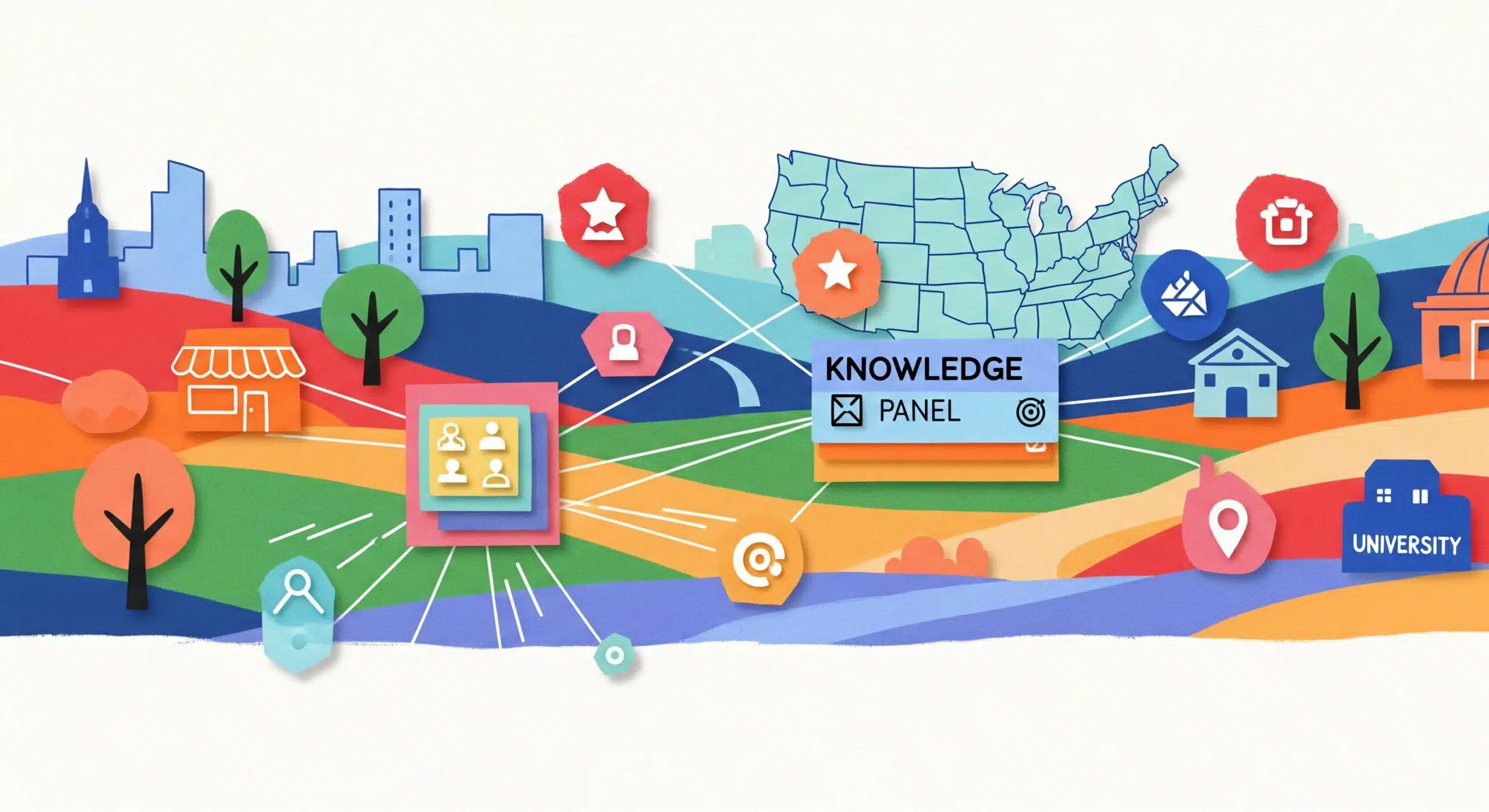
Knowledge panels don’t just add information – they dominate screen real estate. When your brand triggers a knowledge panel, you’re getting the equivalent of multiple organic positions in terms of visibility. These panels pull users’ eyes before they even look at traditional results.
The real power? Knowledge panels appear for branded searches even when you don’t rank #1 organically. They’re your insurance policy against competitors bidding on your brand terms.
Increased Click-Through Rates From Featured Positions
Entities optimized for the knowledge graph get pulled into featured snippets at 3x the rate of traditional content. Why? Because Google trusts structured entity data more than it trusts scraped content. When you define an answer in schema and content, you’re basically handing Google a pre-packaged response.
The click-through rates tell the story: knowledge panel links see 38% CTR on average, while position #1 organic results hover around 28%. That’s a 35% improvement just from entity optimization.
Building Trust and Authority Signals
Users trust knowledge panels. It’s like having Google personally vouch for your business. When searchers see structured information pulled directly into search results, complete with your logo, key facts, and social proof, you’ve already won half the credibility battle.
This compounds over time. Each successful entity interaction teaches Google more about your brand, strengthening future appearances. It’s a virtuous cycle that traditional SEO can’t match.
Local SEO Advantages for Business Entities
Local knowledge graph optimization is where small businesses can absolutely dominate. When you properly connect your business entity to location entities, service area entities, and local landmark entities, you become the de facto authority for your geographic niche.
Picture this: someone asks their phone “Who fixes vintage guitars near the University of Austin?” If you’ve built those entity connections – vintage guitars (Product type), repair services (Service), University of Austin (Location entity) – you’re not competing on keywords. You’re the answer.
Future-Proofing Your Knowledge Graph SEO Strategy
The shift toward entity-based search isn’t slowing down. Google’s MUM and BERT updates, the rise of AI overviews, and the explosion of voice search all point in the same direction: search engines want to understand things, not just match strings.
Start with what you control completely – your own website’s structured data and entity definitions. Build out from there to claim and optimize your presence in external knowledge bases. Connect your entities to the broader web of information. Most importantly, think beyond keywords to relationships.
The brands winning in 2025 won’t be the ones with the most backlinks or the longest content. They’ll be the ones Google truly understands – as entities, not just websites. The knowledge graph SEO benefits are clear: better visibility, higher trust, and positioning that competitors can’t easily replicate. The question isn’t whether to optimize for the knowledge graph, but how quickly you can catch up to where search is already heading.
Remember: every day you delay is another day your competitors are teaching Google who they are. While they’re building entity authority, you’re still counting keywords. Which side of that divide do you want to be on?
FAQs
How does knowledge graph optimization differ from traditional SEO?
Traditional SEO focuses on keywords, content optimization, and backlinks to help pages rank for specific queries. Knowledge graph optimization teaches search engines to understand your brand as an entity with attributes, relationships, and connections. Instead of just ranking for “Chicago pizza restaurant,” you become THE Chicago pizza restaurant entity that Google knows delivers deep dish, was founded in 1943, and has three locations. It’s the difference between matching search terms and being recognized as the definitive answer.
What tools can help build knowledge graphs for SEO?
Start with Google’s own Structured Data Testing Tool and Schema Markup Validator for technical implementation. For planning, tools like Gephi or yEd help visualize entity relationships. WordLift and InLinks automate internal linking based on entity recognition. Kalicube Pro specifically tracks your knowledge panel performance. But honestly? A simple spreadsheet mapping your entities and their relationships beats fancy tools with no strategy.
How do AI overviews impact knowledge graph optimization?
AI overviews pull heavily from structured data and recognized entities – it’s actually easier for AI to summarize information from knowledge graphs than from traditional content. When your business is properly defined as an entity with clear attributes, you’re more likely to be included in AI-generated responses. Think of it this way: AI overviews prefer to cite facts from trusted entities rather than opinions from random websites.
Can small businesses benefit from knowledge graph SEO strategies?
Small businesses actually have an advantage here. While enterprise sites struggle with complex entity relationships across thousands of pages, a small business can comprehensively define their entire entity ecosystem in a weekend. A local bakery can establish stronger entity authority for “artisan sourdough in Portland” than a national chain ever could. The knowledge graph rewards depth over breadth.
What are the key metrics for measuring knowledge graph success?
Forget traditional rankings – measure knowledge panel triggering rate for branded searches first. Track rich result appearances, featured snippet captures, and voice search visibility (through tools like SEMrush’s Sensor). Monitor entity salience scores in Google’s Natural Language API. Watch for increases in branded search volume – when Google understands you better, it suggests you more often. The ultimate metric? Direct traffic growth, because users start searching for you by name, not by what you

Ridam Khare is an SEO strategist with 7+ years of experience specializing in AI-driven content creation. He helps businesses scale high-quality blogs that rank, engage, and convert.