
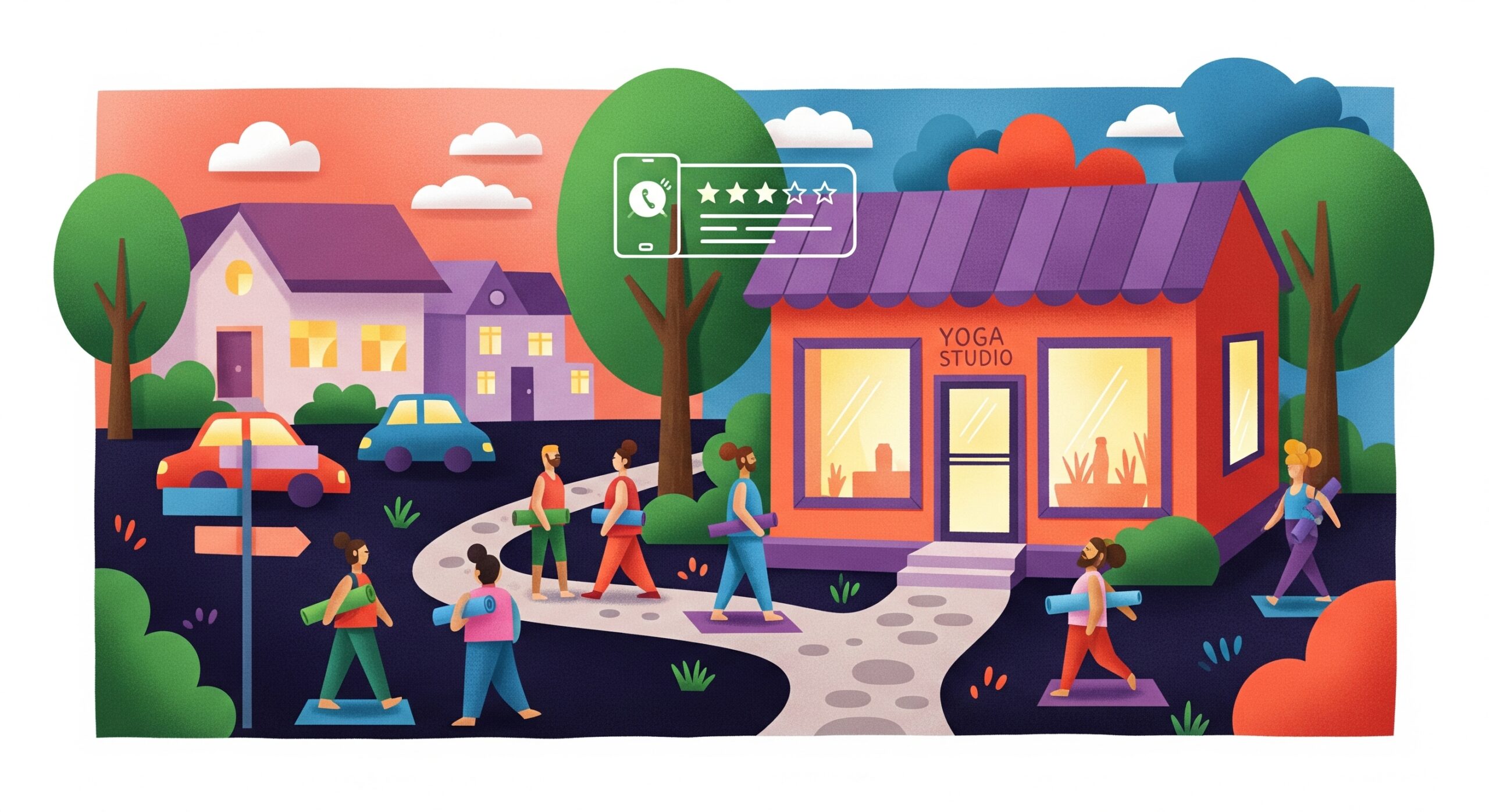
Most yoga studio owners think getting found online is about cramming their website with “yoga” keywords and hoping for the best. That approach stopped working around 2015. The studios actually filling their classes through organic search are doing something entirely different – they’re treating SEO for yoga studios like the local, community-focused marketing channel it really is.
Understanding SEO principles for yoga studios
Think of Google as that friend who’s constantly recommending local spots. When someone types “yoga class near me” at 6:47 AM on a Tuesday, Google wants to show them studios that are actually open, actually nearby, and actually good. Your job isn’t to trick the algorithm. It’s to prove you’re all three.
The fundamental shift happening right now? Google cares more about whether your students show up and come back than whether you’ve perfectly optimized your meta descriptions. (Though yes, you still need those too.) Studios ranking on page one aren’t just technically optimized – they’re genuinely useful to searchers in their neighborhood.
How to Optimize SEO for a Brand New Yoga Instructor’s Website
Starting from scratch feels overwhelming, but here’s what actually matters: pick one neighborhood and own it completely before expanding. Don’t try to rank for “yoga Los Angeles” when you’re teaching out of a converted garage in Silver Lake. Start with “Silver Lake prenatal yoga” or “beginner vinyasa Silver Lake” and build from there.
The technical foundation is simpler than most SEO guides suggest:
A Google Business Profile claimed and fully filled out (this alone can get you visible)
Your teaching schedule clearly displayed on every page
An SSL certificate (that little padlock in the browser)
Mobile responsiveness that actually works when someone’s rushing to find your address
Skip the fancy plugins and focus on these four first. Everything else is optimization.
8 Smart SEO Strategies for Yoga Studios
Here’s the thing about yoga studio website optimization – most studios waste time on strategies that sound good but don’t move the needle. These eight actually work. But honestly? If you only have bandwidth for three, nail numbers 1, 3, and 6.
1. Optimize for Local Search Terms
Forget “yoga studio” as a keyword. Nobody searches that way. They search “hot yoga downtown Portland” or “yoga for bad backs near me” or “7am yoga class Williamsburg.” Your keyword strategy should mirror how people actually talk about finding a class.
Start collecting the phrases your students use when they first call. “Do you have classes for total beginners?” becomes a page targeting “beginner yoga classes [your neighborhood].” That weird question about yoga for runners? There’s your next landing page.
2. Create Location-Specific Landing Pages
If you serve multiple neighborhoods, each deserves its own page. But here’s where studios mess up – they create thin, duplicate content. “We offer yoga in Brooklyn” repeated five times with different neighborhood names. Useless.
Instead, make each page genuinely local:
Parking specifics for that area
Which subway stops or bus lines work best
Nearby landmarks people actually use as reference points
Photos from classes at that specific location
3. Build Google Business Profile
Your Google Business Profile (what old-timers still call Google My Business) matters more than your entire website for local visibility. Most studios set it up once and abandon it. Big mistake.
The studios crushing local search post to their GBP weekly – class highlights, student spotlights, schedule changes. They respond to every review within 24 hours. They use all nine photo categories. They add new photos every week. Sounds excessive? The studio down the street that’s always packed is probably doing exactly this.
4. Target Class-Specific Keywords
Generic “yoga classes” keywords are impossibly competitive. But “prenatal yoga with childcare”? “Yoga for cyclists Saturday morning”? These longer, specific phrases convert like crazy because they match exactly what someone’s looking for.
Build pages around your specialty classes:
Class Type | Target Keywords |
|---|---|
Restorative | “gentle yoga for stress,” “restorative yoga for anxiety” |
Power Yoga | “athletic yoga,” “yoga for strength training” |
Senior Classes | “chair yoga,” “gentle yoga over 60” |
5. Implement Schema Markup
Schema markup sounds technical (because it is), but it’s basically labels that help Google understand your content. For yoga studios, LocalBusiness schema is non-negotiable. It tells Google your hours, location, price range – all the stuff that shows up in those fancy search result cards.
You don’t need to code it yourself. Tools like Schema.org’s generator or even WordPress plugins can handle it. Just make sure you’re using LocalBusiness, not generic Organization schema. The difference matters.
6. Generate Student Reviews
Reviews aren’t just social proof – they’re SEO gold. Every review is fresh content with natural language about your studio. Plus, Google literally shows star ratings in search results. Studios with 4.7 stars and 150 reviews get clicked. Studios with 5 stars and 3 reviews don’t.
The trick? Ask for reviews at emotional high points. Right after someone nails their first crow pose. After a breakthrough in therapy yoga. When they’re glowing post-savasana. Not three days later via automated email when they’re stressed at work.
7. Optimize Site Speed
A yoga studio site shouldn’t take longer to load than a sun salutation. Yet most are bloated with huge images, fancy animations, and unnecessary plugins. Every second of load time costs you visitors – Google’s data shows 53% of mobile users bail after three seconds.
The usual culprits:
That 4MB hero image of your studio (compress it to under 200KB)
Auto-playing video backgrounds (just… don’t)
Twenty different fonts loading for “design”
Chat widgets nobody uses
8. Create Yoga-Focused Content
Content marketing for yoga studios isn’t about churning out “5 Benefits of Yoga” posts nobody reads. It’s about answering the questions your students actually ask. “Can I do yoga with sciatica?” “What should I eat before hot yoga?” “Why do I feel emotional after hip openers?”
Each answer becomes a blog post targeting how to attract more yoga students online. But here’s the key – write for humans first. If you’re stuffing keywords into every paragraph, you’re doing it wrong.
Measuring Your Yoga Studio’s SEO Success
SEO without measurement is just expensive hoping. But most studio owners track the wrong metrics – total traffic, keyword rankings, bounce rate. These matter less than the numbers that actually impact your business.
Key Performance Indicators to Track
Forget vanity metrics. Track what matters:
Local pack appearances: Are you showing up in the map results?
Click-through rate from search: People seeing you is pointless if they don’t click
Contact form submissions: The only traffic that matters is traffic that converts
Class booking sources: Where are online bookings actually coming from?
Phone calls from Google: Track these through your GBP dashboard
Set up Google Analytics 4 (yes, it’s annoying, but do it anyway) and connect it to your booking system. You need to know which keywords actually fill classes, not just which ones bring traffic.
SEO Audit Checklist for Yoga Studios
Run through this monthly SEO audit for yoga studios checklist:
✓ Google Business Profile updated with current hours and holidays
✓ All class schedule changes reflected on website
✓ Reviews responded to within 48 hours
✓ Mobile site tested on actual phones (not just responsive mode)
✓ Local keywords still relevant to your actual offerings
✓ Images compressed and loading quickly
✓ SSL certificate active and not expired
✓ No broken links (check with Broken Link Checker)
✓ Schema markup still validating correctly
Miss any of these for two months and watch your rankings slide.
Timeline for SEO Results
Every studio owner wants to know: how long until SEO works? The honest answer nobody wants to hear: 4-6 months for meaningful results, 12 months for transformation. But (and this is important) you’ll see small wins within weeks if you’re doing it right.
Month 1-2: Your Google Business Profile starts showing up more. Maybe a few extra calls.
Month 3-4: Longer-tail keywords start ranking. Contact forms pick up.
Month 5-6: You notice you’re booked solid for certain classes.
Month 12: You’re turning away students and considering expansion.
Studios that quit at month two never see the compound effect kick in. Stick with it.
Conclusion
Most yoga studio search engine ranking tips focus on technical perfection – perfect keyword density, perfect meta tags, perfect site structure. But the studios actually winning at local SEO understand something different: Google rewards businesses that serve their community well.
You don’t need to master every strategy here. Pick three that match your capacity and nail them. A studio doing three things consistently beats one doing eight things sporadically every time. Start with your Google Business Profile, fix your site speed, and begin collecting reviews. Everything else can wait.
The gap between studios struggling to fill classes and those with waitlists isn’t talent or teaching quality. It’s visibility. And visibility in 2024 means showing up when someone in your neighborhood searches for exactly what you offer. That’s not magic. That’s SEO done right.
Ready to start? Open your Google Business Profile right now and update one thing. Just one. Tomorrow, update another. Small actions compound into big results. Your future students are searching. Time to help them find you.

Ridam Khare is an SEO strategist with 7+ years of experience specializing in AI-driven content creation. He helps businesses scale high-quality blogs that rank, engage, and convert.